
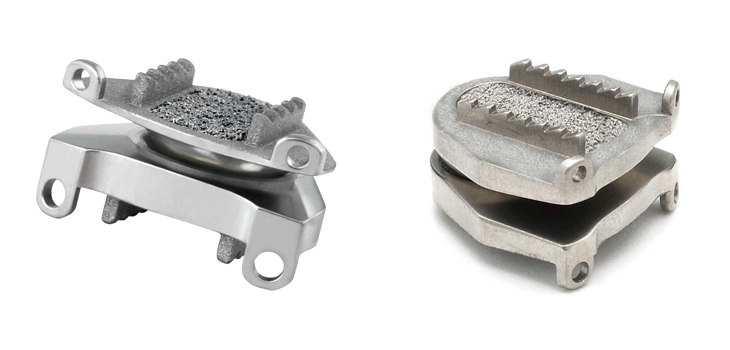
Medtronic plc’s Prestige LP Cervical Disc has “demonstrated greater rates of overall success compared to 2-level ACDF [anterior cervical discectomy and fusion] patients, ” reported Todd Lanman, M.D., at the 84th Annual Meeting of the American Association of Neurological Surgeons (AANS) in Chicago.
Medtronic’s Cervical Disc Beats 2-Level Fusion
1 min read Premium comments
Secondary
In a May 3, 2016 Medtronic press release, the company announced results of seven-year follow-up data demonstrating the clinical outcomes. The study is the longest patient follow-up data for U.S. 2-level cervical disc patients.
The company says a randomized controlled investigational device exemption (IDE) trial included a total of 397 study subjects (209 investigational and 188 control) and compared results up to seven years. Key findings of the statistical analysis at seven years show that the 2-level Prestige LP Disc patients:
- Exhibited greater rates in overall success (78.6%) compared to the patients treated with 2-level ACDF (62.7%) (by using Bayesian statistics, probability of superiority = 99.8%).
- Exhibited greater rates in neurological success (91.6%) compared to the patients treated with 2-level ACDF (82.1%) (probability of superiority= 99.0%).
- Exhibited greater success rates in patient-reported outcomes, including Neck Disability Index (87.0%), compared to the patients treated with 2-level ACDF (75.6%) (probability of superiority = 99.3%).
- Exhibited lower rates of second surgeries (4.2%) at the index levels compared to the patients treated with 2-level ACDF (14.7%).
- Adverse event profiles were similar between groups.
Risks of the disc, according to the company, include, but are not limited to: bone formation (including heterotopic ossification) that may reduce spinal motion or result in a fusion, either at the treated or at adjacent levels.
The disc is pending FDA approval for the 2-level indication.
Author
React:
Discussion
This is a fascinating development. In my practice we've seen similar outcomes with the revised protocol. The key differentiator seems to be patient selection criteria. Has anyone else noticed the correlation with BMI thresholds?
Great point. I'd push back slightly on the conclusion, the sample size in the cited study is too small to draw population-level inferences. That said, the directional signal is compelling and worth a larger RCT.
We implemented a similar approach last year. Early results are promising but we're still gathering 12-month follow-up data. Happy to share our protocol if anyone is interested.
Join the conversation
Orthopedic professionals are discussing this. Sign in and upgrade to read every comment and add your voice.