
MedShape, Inc. is reporting on the first clinical outcomes with the FastForward Bunion Correction System. To date, FastForward has been implanted in over 100 hallux valgus (bunion) correction surgeries.
MedShape: First Outcomes for Bunion System
2 min read Premium comments
Secondary
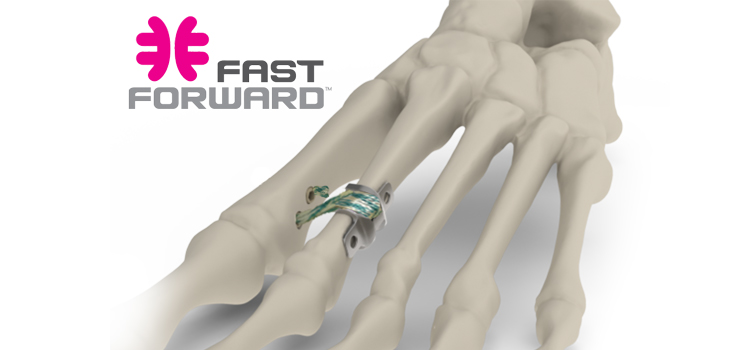
As indicated in the April 25, 2016 news release, “The FastForward system reduces the first-second intermetatarsal (IM) angle and controls first ray hypermobility via a patented tethering approach, thereby providing anatomic correction while still preserving and protecting the bone anatomy. Because there is no osteotomy or fusion performed, patients who receive the FastForward procedure are able to walk immediately in a surgical boot. With the anatomy-matching design of the Bone Tether Plate and by not requiring any drill holes through the second metatarsal, FastForward also reduces unwanted stress concentrations associated with other suture button tethering systems.”
Dawn Buratti, DPM, from Tarzana, California, was one of the first physicians to use the FastForward. She noted, “One of our first FastForward cases was a symptomatic juvenile hallux valgus deformity with significant first ray hypermobility. Traditionally, surgery would have been deferred until age 17 or 18, at which time the deformity would have likely progressed from moderate to severe. However, because the apparatus used in the FastForward procedure is placed mid-shaft, it does not interfere with the growth plates. We were able to provide a surgical option to reduce the IM angle and reduce first ray hypermobility via an intermetatarsal pseudoligament. Post-operative recovery was fully weight bearing in a cam walker boot for 6 weeks. Now 16 months post-surgery, the patient has maintained correction and participates in normal activities, including cheerleading. The procedure provided a nice alternative to what otherwise would have necessitated a lapidus fusion or a base wedge osteotomy.”
Jason Lin, M.D. from Good Samaritan Hospital in Corvallis, Oregon, commented, “The FastForward bunionectomy procedure has been a game changer for my practice. It has become my preferred technique for correction of most hallux valgus deformities. The FastForward is a reproducible system with a relatively quick learning curve and excellent clinical results. Compared to other techniques that require osteotomies or fusions, my patients have reported faster resolution of post-operative pain and swelling. In addition, I feel more comfortable allowing patients to transition back into normal footwear without fear of non-union. Radiographically, I have been impressed with the more anatomic appearance of the first metatarsal (vs. non-anatomic osteotomies), which allows for more reliable measurements of IM and hallux valgus angles, and with the ability to restore sesamoid position.”
Ken Gall. Ph.D., Chief Technology Officer for MedShape, told OTW, “The biggest challenge was developing an implant system that would not create any stress risers in the second metatarsal. The FastForward system first accomplishes this by eliminating drilling through the second metatarsal, instead wrapping the suture tape around the bone in a cow-hitch knot. Second, we were able to closely match the second metatarsal anatomy by leveraging 3-D printed titanium technology to manufacture the Bone Tether Plate. This design distributes the stresses optimally on the bone and a looped portion allows the suture tape to pass and securely hold the plate in place without the need for bone screws.”
React:
Discussion
This is a fascinating development. In my practice we've seen similar outcomes with the revised protocol. The key differentiator seems to be patient selection criteria. Has anyone else noticed the correlation with BMI thresholds?
Great point. I'd push back slightly on the conclusion, the sample size in the cited study is too small to draw population-level inferences. That said, the directional signal is compelling and worth a larger RCT.
We implemented a similar approach last year. Early results are promising but we're still gathering 12-month follow-up data. Happy to share our protocol if anyone is interested.
Join the conversation
Orthopedic professionals are discussing this. Sign in and upgrade to read every comment and add your voice.