
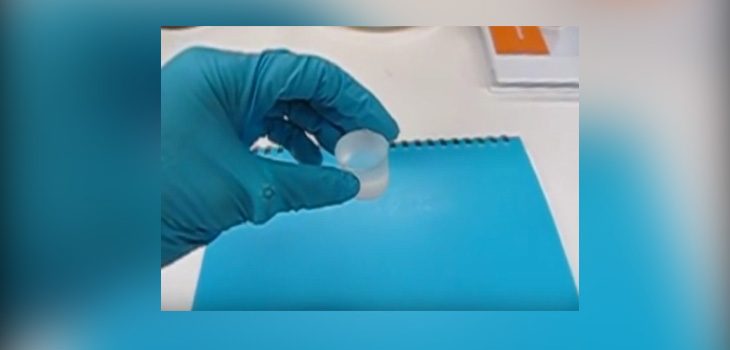
Scientists have developed a material made of silica and plastic that can mimic cartilage and just may encourage it to re-grow.
Material Mimics Cartilage, Encourages Re-Growth
2 min read Premium comments
Secondary
According to the May 12, 2016, news release, “The researchers from Imperial College London and the University of Milano-Bicocca have developed a bio-glass material that mimics the shock-absorbing and load bearing qualities of real cartilage. It can be formulated to exhibit different properties, and they are now hoping to use it to develop implants for replacing damaged cartilage discs between vertebrae. They believe it also has the potential to encourage cartilage cells to grow in knees, which has previously not been possible with conventional methods.”
The polymer in the bio-glass is called polycaprolactone, which displays cartilage-like properties including being flexible, strong, durable, and resilient—it in fact displays self-healing properties when damaged. Bio-glass can also be made in a biodegradable ink form, which means researchers could 3D print it into structures or scaffolds that encourage cartilage cells in the knee to form and grow. So far, though, they have demonstrated this process in test tubes only. The scientists also believe they will be able to engineer synthetic bio-glass cartilage disc implants, which would have the same mechanical properties as real cartilage, but which would not need the metal and plastic devices that are currently available.
Professor Julian Jones, one of the developers of the bio-glass from the Department of Materials at Imperial, said, “Bio-glass has been around since the 1960s, originally developed around the time of the Vietnam War to help heal bones of veterans, which were damaged in conflict. Our research shows that a new flexible version of this material could be used as cartilage-like material.”
Professor Justin Cobb is the Chair in Orthopaedic Surgery at Imperial’s Department of Medicine. He will be co-leading on the next stage of the research.
Professor Cobb told OTW, “Julian and his team have done that exciting thing of taking known chemicals and technologies and combining them in a way that hadn’t been possible before. The product is an entirely new class of biomaterials, which may hold the key to rewriting the interface between our own skeletal system and artificial constructs that are used in repair and regeneration.”
“All orthopaedic surgeons are constantly aware that devices we use have to be strong enough not to break, or fail through fatigue, until healing is complete. In consequence, many devices are thousands of times stiffer than normal tissues. This explains in part why many patients, while grateful for their operation, do not feel normal and in the longer term may suffer the consequences of stress shielding by the stiff artificial device. With this new product family, Julian and his team may be able to create a new class of biomaterial, where the stiffness and durability can be programmed in for the purpose required. It’s an exciting prospect, particularly for the older patient with softer bone, where the materials used are mismatched in stiffness today, with the certainty that the mismatch will increase over the decades to come. I can foresee exciting applications in arthroplasty, trauma fixation and spinal surgery, although there is some way to go before the first human trials, ” continued Cobb.
React:
Discussion
This is a fascinating development. In my practice we've seen similar outcomes with the revised protocol. The key differentiator seems to be patient selection criteria. Has anyone else noticed the correlation with BMI thresholds?
Great point. I'd push back slightly on the conclusion, the sample size in the cited study is too small to draw population-level inferences. That said, the directional signal is compelling and worth a larger RCT.
We implemented a similar approach last year. Early results are promising but we're still gathering 12-month follow-up data. Happy to share our protocol if anyone is interested.
Join the conversation
Orthopedic professionals are discussing this. Sign in and upgrade to read every comment and add your voice.