
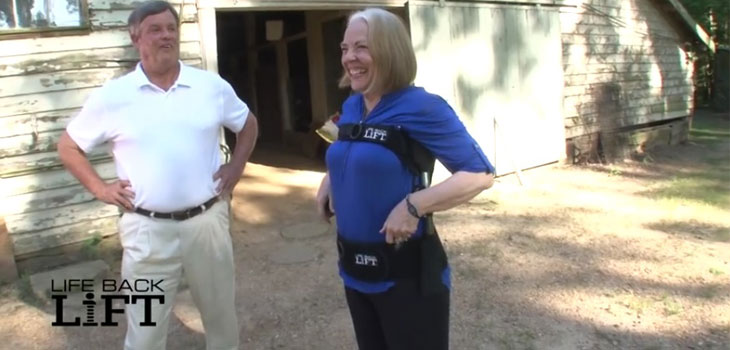
Go ask “the people”…VerteCore Technologies is doing just that with the launch of its crowdfunding campaign for the financing of the first production run of its brand new VerteCore Lift. The company says that it has worked with leading mechanical and electrical engineers on several different prototypes. As indicated in the April 11, 2016 news release, “The VerteCore Lift provides affordable, comfortable, convenient, mobile spinal decompression for people who suffer from chronic lower back pain created by bulging discs, herniated discs and other spine conditions that put pressure on and pinch sensitive spinal cord nerves.”
VerteCore: Crowdfunding for Mobile Spinal Decompression
2 min read Premium comments
Secondary
“The VerteCore Lift has been evaluated and peer-reviewed by a wide range of medical doctors that see the FDA Class 1-cleared medical device as a tremendous step forward in providing a more effective solution at treating many different forms of low back pain including degenerative disc disease, sacroiliac joint dysfunction, sciatica, spinal lumbar stenosis, functional scoliosis, bulging and herniated discs.”
As the name implies, the Lift effectively stretches or decompresses the spine and allows the ruptured annulus fibrosus of intervertebral discs to go through a process known as “resorption, ” which means when pressure is relieved, it allows the ruptured disc’s nucleus pulposus to retreat back inside the annulus fibrosus thus decreasing pressure on spinal nerve roots which cause low back pain.
Paul Leake, CEO, VerteCore Technologies, told OTW, “Early on, as a patient looking to avoid surgery, the challenge was finding reliable information about alternative back pain treatments. Between my co-inventor and I, we had tried just about every product we could get our hands on. From those purchased through clinicians to ones that are advertised on late night infomercials. Either they did nothing or just did not perform as advertised. It was very frustrating trying to find an effective alternative to surgery. Especially when you factor in the desire for convenience and wanting a more active lifestyle as opposed to your life revolving around time consuming doctor appointments and taking pain meds.”
“Once an effective prototype of the VerteCore Lift was developed, the challenges shifted over to those more typical for medical device innovations: testing, securing IP, FDA clearance, and now we’re moving onto validation as we educate the general public with back pain and the clinicians that treat these patients symptoms.”
“I would never presume to tell a doctor what protocols to follow, but in relaying the universal need of patients to know the alternatives available, I would ask that they embrace a patient-centric approach.”
“The VerteCore Lift was designed to provide a convenient, non-intrusive, viable option to explore before surgery and the potential risk from opioid complications while trying to mitigate pain. The Lift has been extremely effective and the convenience to the patients means they are more likely to adhere to the doctor’s treatment plan. Being able to decompress the spine during normal daytime activities is the main product feature that sets the VerteCore Lift apart from other traction medical devices. It is the perfect “last step” for patients who are considering back surgery.”
React:
Discussion
This is a fascinating development. In my practice we've seen similar outcomes with the revised protocol. The key differentiator seems to be patient selection criteria. Has anyone else noticed the correlation with BMI thresholds?
Great point. I'd push back slightly on the conclusion, the sample size in the cited study is too small to draw population-level inferences. That said, the directional signal is compelling and worth a larger RCT.
We implemented a similar approach last year. Early results are promising but we're still gathering 12-month follow-up data. Happy to share our protocol if anyone is interested.
Join the conversation
Orthopedic professionals are discussing this. Sign in and upgrade to read every comment and add your voice.