
Patients who are relieved to have that knee replacement done may have a surprise waiting for them in the future. Swedish researchers have found an increasing risk for hip and vertebral fracture in the 10 years after knee replacement. The new study was led by Cecilie Hongslo Vala, Ph.D., of the Sahlgrenska Academy in Gothenburg, Sweden. Dr. Vala told OTW, “We followed the entire Swedish population born 1902 to 1952 (n=4, 546, 820) during the period 1987 to 2002. We identified from the patient register patients with total knee replacement (TKR) due to primary osteoarthritis (n=41, 745), hip fracture (n=213, 323) and vertebral fracture (n=43, 604). We found that patients with TKR had a 42% reduced risk (hazard ratio 0.58; 95% confidence interval 0.54-0.63) of sustaining a hip fracture and 45% reduced risk (hazard ratio 0.55; 95% confidence interval 0.47-0.65) of sustaining a vertebral fracture in the 10 years period before the surgery, compared to the general population without TKR.”
TKR…Then a Hip/Vertebral Fracture?
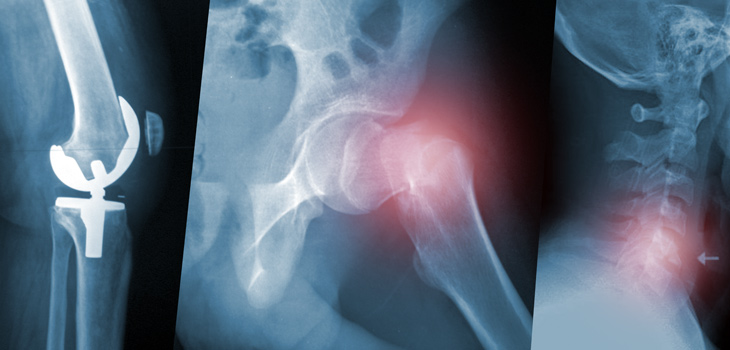
“In the 10 years period after surgery patients with TKR have a 4% increased risk of sustaining hip fracture (hazard ratio 1.04; 95% confidence interval 1.00-1.09) and a 19% increased risk of vertebral fracture (hazard ratio 1.19; 95% confidence interval 1.09-1.31), compared to the general population without TKR.”
In the April 18, 2016 news release, Dr. Vala noted, “The increasing risk for hip and vertebral fracture in the 10 years after knee replacement may be explained by pain, increase of physical activity due to rehabilitation, and other biomechanical factors.”
Asked about study limitations, Dr. Vala told OTW, “The study does not include events of TKR, hip fracture or vertebral fracture before 1987 and after 2002. And we have no knowledge of comorbidity.”
Discussion
This is a fascinating development. In my practice we've seen similar outcomes with the revised protocol. The key differentiator seems to be patient selection criteria. Has anyone else noticed the correlation with BMI thresholds?
Great point. I'd push back slightly on the conclusion, the sample size in the cited study is too small to draw population-level inferences. That said, the directional signal is compelling and worth a larger RCT.
We implemented a similar approach last year. Early results are promising but we're still gathering 12-month follow-up data. Happy to share our protocol if anyone is interested.
Join the conversation
Orthopedic professionals are discussing this. Sign in and upgrade to read every comment and add your voice.