
Renovis Surgical Technologies, Inc. has received FDA clearance for the first-ever 3D printed titanium stand-alone cervical cage.
Renovis: FDA Clearance for 3D Printed Cervical Cage
1 min read Premium comments
Secondary
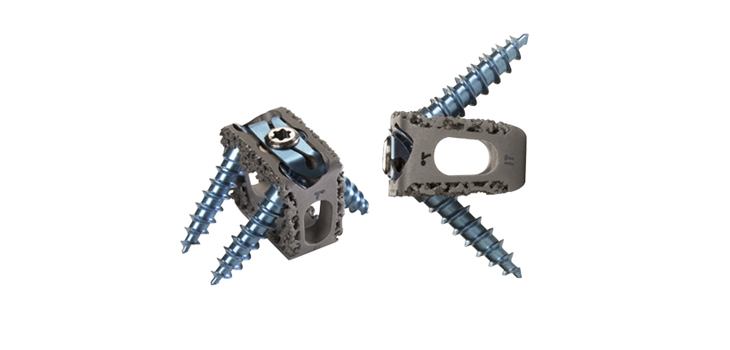
As indicated in the March 30, 2016 news release, “the Tesera SC is a porous titanium stand-alone cervical interbody fusion system featuring a three-screw design and a locking cover plate to prevent screw backout. Implants are available in two lordotic angles with varying heights and footprints for proper intervertebral height restoration, along with advanced instrumentation designed to reduce operative steps.”
Trace Cawley, V.P. of Sales and Marketing, Spine, told OTW, “Working with additive manufacturing is getting to be pretty straightforward for us, as this is our fourth product cleared through FDA with this process and porous structure. The most challenging problem came from design challenges related to cramming three cervical screws and a strong locking system into a limited space. We went through many iterations before finally settling on the launch version.”
“As for sales and marketing plans over the next 6-12 months…near term, we are focused on a successful launch for the Tesera SC, as well as expanding our market presence with Tesera SA. Next on deck this year will be a suite of posterior Tesera interbody cages, for PLIF and TLIF. The addition of those systems will give us a near-complete Tesera interbody line. That brings us to NASS [North American Spine Society], where we hope to show some future additions to the Tesera family.”
React:
Discussion
This is a fascinating development. In my practice we've seen similar outcomes with the revised protocol. The key differentiator seems to be patient selection criteria. Has anyone else noticed the correlation with BMI thresholds?
Great point. I'd push back slightly on the conclusion, the sample size in the cited study is too small to draw population-level inferences. That said, the directional signal is compelling and worth a larger RCT.
We implemented a similar approach last year. Early results are promising but we're still gathering 12-month follow-up data. Happy to share our protocol if anyone is interested.
Join the conversation
Orthopedic professionals are discussing this. Sign in and upgrade to read every comment and add your voice.