
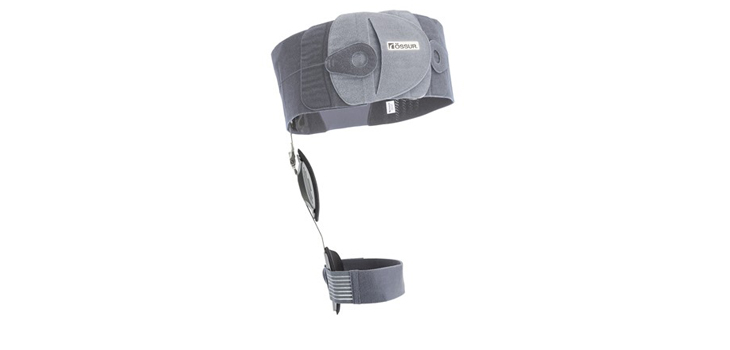
Össur is announcing the launch of the Rebound Hip, a lightweight brace for patients recovering from hip arthroscopy, gluteus medius repair or hamstring repair surgery. As indicated in the April 11, 2016 news release, “Femoroacetabular impingement (FAI) is typically seen in high-level athletes and other physically active individuals, and often causes cartilage damage, labral tears, early hip arthritis, hyperlaxity, sports hernias, and low back pain.”
Össur Launches Rebound Hip
1 min read Premium comments
Secondary
“More than 130, 000 hip arthroscopies are performed annually worldwide, and the vast majority of cases are caused by FAI, ” said Jason Thorne, Össur’s vice president of Global Marketing OA&I Solutions. “We developed Rebound Hip specifically so that clinicians could help this growing population of patients with a low-profile, lightweight solution intended to aid in their recovery and restore their mobility.”
Thorne told OTW, “Our challenge was developing a functional rehab brace for post-surgical outcomes while increasing patient compliance. In the past, patient compliance was low with post-op hip bracing due to the bulky nature of braces on the market and hip arthroscopists were asking for a brace to increase their patient compliance during rehab. The new Rebound Hip brace is designed to provide functional range-of-motion restriction in flexion/extension and abduction/adduction, while being lightweight and comfortable enough for patient’s to wear it.”
“The Rebound Hip can be customized to patient’s anatomy with the universal belt and adjustable telescoping frame to adjust the length. This allows the brace to be easy-to-stock, assemble and provide a customizable fit to the patient’s anatomy. Another unique feature of the Rebound Hip is the floating hinge that allows the patient to sit comfortably in the brace without it riding up. Our ultimate goal is to improve patient compliance through increased comfort, while creating a functional brace to optimize post-operative protocols.”
Author
React:
Discussion
This is a fascinating development. In my practice we've seen similar outcomes with the revised protocol. The key differentiator seems to be patient selection criteria. Has anyone else noticed the correlation with BMI thresholds?
Great point. I'd push back slightly on the conclusion, the sample size in the cited study is too small to draw population-level inferences. That said, the directional signal is compelling and worth a larger RCT.
We implemented a similar approach last year. Early results are promising but we're still gathering 12-month follow-up data. Happy to share our protocol if anyone is interested.
Join the conversation
Orthopedic professionals are discussing this. Sign in and upgrade to read every comment and add your voice.