
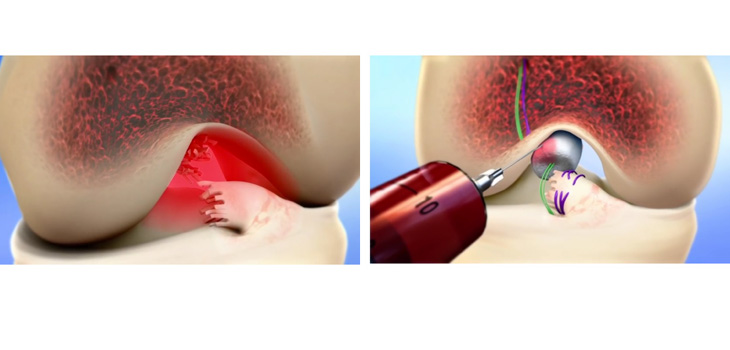
Stimulating healing with a sponge/bridge…Martha Murray, M.D., an orthopedic surgeon with Boston Children’s Hospital, has developed a new type of anterior cruciate ligament (ACL) repair. Known as bio-enhanced ACL repair (BEAR), it connects the torn ligament with a sponge (functioning as a bridge) as a means to encourage the body to regenerate tissue naturally. According to the Boston Children’s Hospital BEAR website, there is no graft harvest of patient’s tendon and the remaining ACL tissue is preserved.
New Type of ACL Repair!
1 min read Premium comments
Secondary
Dr. Murray told OTW, “The most interesting moments were when, as a team, we saw the results, both in the preclinical and clinical studies—to see what happened in the knee in the weeks after surgery. The knee is a bit of a black box post-operatively—we can monitor for stiffness and swelling and stability on the outside but to be able to actually see what is going on inside using MRI is great.”
“This technology is still in its very early stages of clinical study—we will need a lot more follow up of these patients and of other patients to truly determine if this will be a reasonable alternative to ACL reconstruction in the future.”
Video courtesy Boston Children’s Hospital: http://www.childrenshospital.org/centers-and-services/programs/a-_-e/anterior-cruciate-ligament-program/bridge-enhanced-acl-repair-trial
React:
Discussion
This is a fascinating development. In my practice we've seen similar outcomes with the revised protocol. The key differentiator seems to be patient selection criteria. Has anyone else noticed the correlation with BMI thresholds?
Great point. I'd push back slightly on the conclusion, the sample size in the cited study is too small to draw population-level inferences. That said, the directional signal is compelling and worth a larger RCT.
We implemented a similar approach last year. Early results are promising but we're still gathering 12-month follow-up data. Happy to share our protocol if anyone is interested.
Join the conversation
Orthopedic professionals are discussing this. Sign in and upgrade to read every comment and add your voice.