
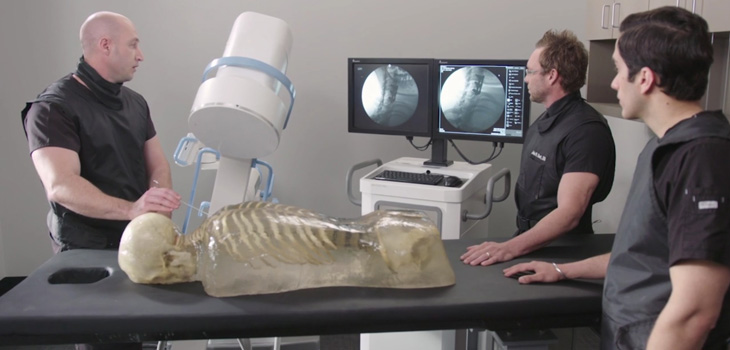
A new medical device called AsTris 1.0 is now available help doctors get the pain management experience they need without having to practice on a real person. Developed by BioTras, LLC, AsTris 1.0 made its debut in Dallas at the 2016 American Society of Interventional Pain Physicians (ASIPP) conference April 14-16 at the Hyatt Regency.
New Pain Management Training Device Rolled Out
1 min read Premium comments
Secondary
Johnny East, DO and Brandon Knutson, DC are co-owners of BioTras.
“As an emerging med-tech company based in Dallas, this is the perfect venue to launch our first medical device, ” said Dr. East, who is board certified in Physical Medicine & Rehabilitation and Pain Medicine and has performed over 20, 000 spinal injections over the course of his 14-year career. “We will get the chance to showcase AsTris 1.0 in front of thousands of the best minds in interventional pain management, including physicians, nurses and other health care providers.”
According to the April 11, 2016 news release, “The AsTris 1.0 body is clear, which allows the practitioner to observe needle movement as the needle is advanced towards the spine. It can also be customized to include a variety of skeletal structures to meet a wider scope of training needs. The simulator is different than anything currently on the market and is made of a fusable thermo plastic material. It is also made of re-constructed human vertebrae, and other real bone elements that can be viewed under X-ray.”
“BioTras expects the second and third generation models of AsTris 1.0 to be used in training for specialties outside of pain management such as neurosurgery and orthopedic surgery.”
Dr. East, , told OTW, “AsTris 1.0 arose from an organic need in the field of musculoskeletal medicine for a new kind of training; one where the eye and hand can meet more effectively. The most interesting practical aspect of AsTris 1.0 is that the simulated thermoplastic material is reusable an indefinite number of times. AsTris 1.0 is authentic. It looks real under X-ray and to the naked eye because it is real.”
React:
Discussion
This is a fascinating development. In my practice we've seen similar outcomes with the revised protocol. The key differentiator seems to be patient selection criteria. Has anyone else noticed the correlation with BMI thresholds?
Great point. I'd push back slightly on the conclusion, the sample size in the cited study is too small to draw population-level inferences. That said, the directional signal is compelling and worth a larger RCT.
We implemented a similar approach last year. Early results are promising but we're still gathering 12-month follow-up data. Happy to share our protocol if anyone is interested.
Join the conversation
Orthopedic professionals are discussing this. Sign in and upgrade to read every comment and add your voice.