
Joshua Jacobs, M.D. Elected as ABOS Director
Joshua Jacobs, M.D. Elected as ABOS Director // HSS Study: PNBs Associated With Better Outcomes // And More!
5 min read Premium comments
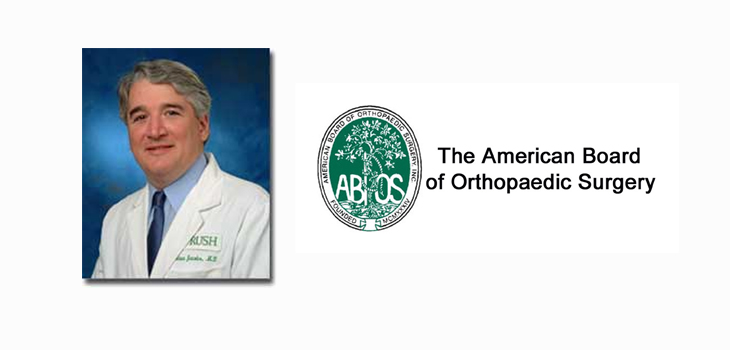
The Board of Directors of the American Board of Orthopaedic Surgery (ABOS) recently elected Joshua Jacobs, M.D., Chairman of Orthopedic Surgery at Rush University Medical Center, as a new director. He begins service on the Board immediately.
Dr. Jacobs completed his orthopedic residency training at the Combined Harvard Orthopaedic Residency Program in Boston and his fellowship in Adult Reconstructive Orthopaedic Surgery at Rush. He holds the positions of Associate Provost for Research at Rush University and Vice Dean for Research at Rush Medical College. Dr. Jacobs is a past president of the Orthopaedic Research Society and the United States Bone and Joint Decade/Initiative.
Dr. Jacobs told OTW, “I’m honored to be elected to the American Board of Orthopaedic Surgery, a very important organization in our field. It is a talented group of some of the top orthopaedic surgeons in the world. I have been asked to serve on several committees: oral examination, written examination, Maintenance of Certification, credentials, and research. There are many exciting things happening on each of these committees and I look forward to jumping right in. While I’ve known most of the Board members for many years and have worked with ABOS for a long time, I look forward to learning even more about ABOS and finding the best ways I can help.”
Peripheral Nerve Blocks Associated With Improved Outcomes?
A team of researchers from Hospital for Special Surgery (HSS) has found that peripheral nerve blocks (PNBs) are associated with better outcomes following hip and knee replacement. The study was selected as a “Best of Meeting” winner at the recent Annual Regional Anesthesiology and Acute Pain Medicine Meeting.
Stavros G. Memtsoudis, M.D., Ph.D., was lead investigator on this study, which involved 342, 726 patients who had a hip replacement and 719, 426 who had knee replacement surgery.
Dr. Memtsoudis told OTW, “Our research group has recently published data suggesting that the use of spinal and epidural anesthesia is a major determinant of good outcomes among joint arthroplasty patients, spearheading practice and policy changes around the globe. Intrigued by the finding that anesthesia can play a major role in perioperative outcomes, we decided to study the impact of peripheral nerve blocks, which are used because of their superior pain management profile for decades, on important clinical and economic outcomes.”
“Patients who received PNBs after hip and knee arthroplasties had an overall reduction in major complications by 28% and 19%, respectively. The odds for developing cardiac complications were 0.78 (CI 0.68; 0.89) and 0.72 (CI 0.67; 0.76) compared to those not receiving a PNB, respectively. Wound complications were reduced by 46% and 11%, and infections by 25% and 23%.”
“The odds for blood transfusions, intensive care services, and prolonged length of stay (above 75th percentile) were 0.86 (0.81; 0.92), 0.61. (0.55; 0.67) and 0.74; (0.70; 0.78) for hip arthroplasties and 1.02 (0.99; 1.05), 0.94(0.99; 0.98) and 0.74(0.72; 0.75) for knee replacements. The odds for being in the highest quartile for opioid consumption were reduced by 34% for either surgery.”
Regarding future research, Dr. Memtsoudis commented to OTW, “These findings are important, as they suggest in a large population-based cohort reflecting real world practice that PNBs can positively affect perioperative outcomes beyond better pain control. The fact that they are utilized in less than a fourth of patients countrywide could point to a great opportunity to improve public health on a large scale, given that over 1 million joint arthroplasties are performed annually in the U.S. alone. Further research should focus on establishing mechanisms by which PNBs improve outcomes. Targeted clinical studies may help elucidate and validate their impact on various complications.”
Doctors, Hospitals…Get Aligned!
Medicare’s Comprehensive Care for Joint Replacement (CJR) is here. Effective April 1, 2016, hundreds of hospitals have the opportunity (or feel the pressure) to reduce cost and improve quality for patients undergoing lower extremity joint replacement (LEJR). Richard S. Yoon, M.D. executive chief resident at the New York University Hospital for Joint Diseases, tells OTW, “Major obstacles lie in getting everyone on-board. Alignment is an agreement between the hospital administration, all of the ancillary staff and the physicians to come together in a concerted effort to maximize quality care without maximizing how much you spend. Either way you look at it, you cannot spend all the money in the world to maximize quality because that’s not feasible, and conversely, you cannot justify compromising quality just to keep cost down. It is a delicate balance.”
“Everyone needs to buy in and come up with a ‘quality protocol’ that maximizes efficiency and removes redundancies to drive down cost. Driving down cost also means approaching, together as a team, hitting and surpassing quality metrics as an institution in order to avoid penalties and ensure that reimbursements are maximized (which also conversely means delivering quality care). Driving down costs also means negotiating with implants companies to get the best price. Additionally, patient education is key, where preoperative education as well as close follow-up by individuals is also important (especially when you are sending the majority of your patients home and not to rehab). Individually, physicians/surgeons cannot only benefit via gain sharing, but also because eventually, all of our profiles and metrics will be made public, which in itself has its own motivational components to provide quality care.”
Regarding the hoped-for seamless episode of care, Dr. Yoon told OTW, “An episode of care commences even before someone is booked for surgery. In the realm of total joint implants we must identify risk factors that patients have that might increase the risk of infection or readmission within the acute, 90 day readmission period. Prior to even booking the patient for surgery, if we can modify their risk profile and decrease their chance of complications, that’s better. This is not necessarily delaying needed care, but instead optimizing someone’s overall health, minimizing their risk, and maximizing their outcome. If someone is a smoker or an uncontrolled diabetic I would say to that person, ‘I would love to offer you a hip replacement, but your A1C is high and you smoke, so there would definitely be postoperative complications. Let’s work with your primary care physician so that you can quit smoking and get your sugar under control.’”
“The role of the ‘surgeon champion’ is to be a liaison between hospital, fellow surgeons, as well as industry. At our institution, Joseph Zuckerman, M.D., Richard Iorio, M.D., and Joseph Bosco, M.D. have done a wonderful job of negotiating and decreasing implant cost, getting administrative, ancillary staff, and surgeon buy-in, and compiling a successful gain sharing model. If we can be under the allotted cost for each case then the savings from Medicare, then participating surgeons, as well as the institution will benefit.”
Asked about possible obstacles to implementation, Dr. Yoon commented to OTW, “You need total buy-in. Even if one surgeon does not participate, this can be a huge wrench in the machine, which may render the model inefficient and costly. Each institution and system is different, and finding that delicate balance is the most difficult part.”
Author
React:
Discussion
This is a fascinating development. In my practice we've seen similar outcomes with the revised protocol. The key differentiator seems to be patient selection criteria. Has anyone else noticed the correlation with BMI thresholds?
Great point. I'd push back slightly on the conclusion, the sample size in the cited study is too small to draw population-level inferences. That said, the directional signal is compelling and worth a larger RCT.
We implemented a similar approach last year. Early results are promising but we're still gathering 12-month follow-up data. Happy to share our protocol if anyone is interested.
Join the conversation
Orthopedic professionals are discussing this. Sign in and upgrade to read every comment and add your voice.