
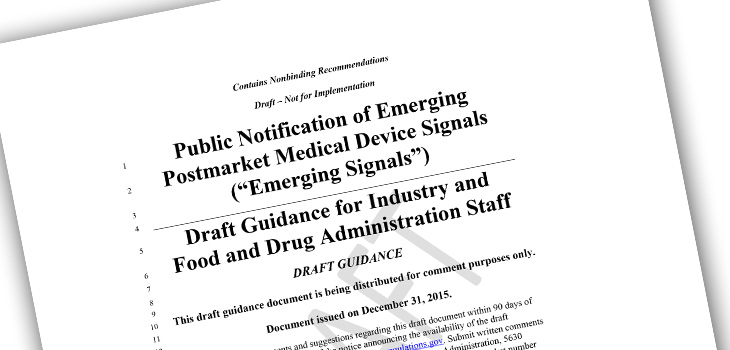
At the end of 2015, the FDA proposed a plan for notifying the public about medical device “emerging signals.”
Industry Opposes FDA “Emerging Signals” Proposal
2 min read Premium comments
Secondary
An emerging signal, stated the proposal, is new information about a medical device used in clinical practice:
- that the agency is monitoring or analyzing,
- that has the potential to impact patient management decisions and/or alter the known benefit-risk profile of the device,
- that has not yet been fully validated or confirmed, and
- for which the agency does not yet have specific recommendations.
On April 1, 2016, the agency made public the comments submitted by AdvaMed and the Medical Device Manufacturers Association (MDMA). The trade groups went ballistic.
The MDMA said it was, “unclear how this additional process would improve the system. In fact, there may be unintended consequences related to unvalidated information being relied upon by patients, providers and the public to make certain clinical decisions that may not be in a patient’s best interest.”
AdvaMed said the FDA had failed to “articulate a reasonable basis to communicate emerging signals to the public. In fact, FDA acknowledges that the release of an emerging signal to the public may deter use of a safe and effective medical device. A scientifically-driven regulatory agency should define clearly the strength of evidence and uncertainty that has resulted in the public communication of information about previously cleared or approved devices.”
AdvaMed even went on to question the FDA’s statutory authority to communicate such emerging signals and notes that the release of incorrect, incomplete, or misleading information on a device will negatively impact its use and patient well-being. FDA’s current ability to communicate information on medical device reporting, recalls and associated communications via safety communications, alerts and press releases is sufficient.”
Industry “Profoundly Concerned”
“We are profoundly concerned that emerging signal communications issued prior to the Agency having adequate, fully analyzed, validated and confirmed evidence, and without appropriate instructive recommendations, will create unnecessary confusion for healthcare providers and patients and could have unintended consequences including an adverse impact on public health and long-lasting reputational damage to valuable devices, ” AdvaMed continued.
The trade group also pointed out that the Quality System Regulations require manufacturers to continually evaluate risks associated with their devices through postmarket monitoring activities and initiate corrective actions when necessary.
FDA Rationale
The agency said it believes there is a need to notify the public about emerging signals that the FDA is monitoring or analyzing, “even when the information has not been fully analyzed, validated or confirmed, and for which the Agency does not yet have specific recommendations.”
“Because of the evolving nature of this information, FDA would be sharing it with the public at an early stage of the Agency’s assessment and evaluation of the signal.”
Further, in contrast to a device safety communication, a communication regarding an emerging signal may lack certainty about the significance of the information, including whether it represents a new, potentially causal association, or a new aspect of a known association (e.g., increased rate or severity of event), between a medical device and one or more adverse events or outcomes.
There was no further information on the FDA’s website as to the eventual implementation of the proposal.
To read the entire proposal, click here.
Author
React:
Discussion
This is a fascinating development. In my practice we've seen similar outcomes with the revised protocol. The key differentiator seems to be patient selection criteria. Has anyone else noticed the correlation with BMI thresholds?
Great point. I'd push back slightly on the conclusion, the sample size in the cited study is too small to draw population-level inferences. That said, the directional signal is compelling and worth a larger RCT.
We implemented a similar approach last year. Early results are promising but we're still gathering 12-month follow-up data. Happy to share our protocol if anyone is interested.
Join the conversation
Orthopedic professionals are discussing this. Sign in and upgrade to read every comment and add your voice.