
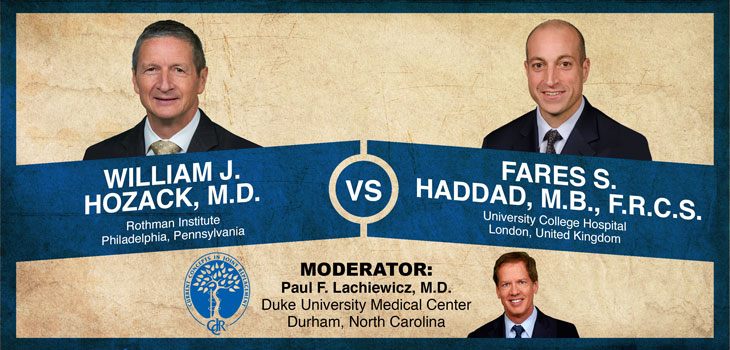
This week’s Orthopaedic Crossfire® debate was part of the 32nd Annual Current Concepts in Joint Replacement® (CCJR) – Winter meeting, which took place in Orlando this past December. This week’s topic is “The Anterior Approach: Better, Faster, Cheaper.” For the proposition is William J. Hozack, M.D., Rothman Institute, Philadelphia, Pennsylvania. Opposing is Fares S. Haddad, M.B., F.R.C.S., University College Hospital, London, United Kingdom. Moderating is Paul F. Lachiewicz, M.D., Duke University Medical Center, Durham, North Carolina.
Hozack v. Haddad: The Anterior Approach: Better, Faster, Cheaper
9 min read Premium comments
Great Debates
Dr. Hozack: Direct anterior approach [DAA] is not something new. It’s been around for over a century, but the question is, is it faster, better or cheaper. So let’s try to look at the data and make an argument on those points.
First question, do the patients recover faster? Well, you look at some of the articles (4) published suggesting, ‘Yes, they do.’ Most show that direct anterior approach recovers faster and some do suggest the opposite (2). So the score for me is 4 to 2. DAA wins.
Is it cheaper? Maybe a little cheaper.
Is it better? That’s the more important question. It is MIS (minimally invasive surgery), done properly. It is an approach between nerves and between muscles. The other approaches are not MIS in that respect because they go through muscles and within one nerve. The DAA done properly spares the gluteal muscles and, specifically, the gluteus maximus muscle, which is an important muscle for the hip function.
Posterolateral cuts many muscles and you get a great view, but it’s not MIS.
And I do believe soft tissue damage affects functionality. The consequences are reflected in weakness, limp, soreness, heterotopic ossification [HO], and, ultimately, disappointment for the patient and for the surgeon.
There are some published data on this. The incidence of HO is actually no different, so in fact, there is an equal amount of trauma occurring, or lack of trauma.
One paper published in a prominent journal suggests that all markers of inflammation and insult to the muscles are lower with the direct anterior approach. But more importantly, did the patient have a better outcome, because that’s really what it’s all about.
We have two studies, suggesting that indeed the anterior approach has a better outcome, clinically. But there are also two studies suggesting that this is not the case. So we have a tie in this regard.
How about complications? Again, if you go through the literature, there is an equal number of studies one way or the other suggesting the complication rates can be higher, especially in the learning curve. Or that once you get through the learning curve, they’re equivalent.
There are some specific complications related to the direct anterior and that is lateral femoral cutaneous nerve neuropraxia. Basically we just tell our patients they’re going to have some numbness in the thigh. Just like we tell our total knee replacement patients that they’re going to have numbness lateral to the incision. We still continue to do a midline incision for the knee.
Wound healing. There is some debate about whether wound healing complications are higher with a direct anterior as opposed to other approaches. There’s no question that it is higher just like other approaches in people that are obese. But if you look at what’s published, the answer is it’s basically a tie.
There are some specific complications we don’t have to worry about for direct anterior. Dislocation. Dislocation. Dislocation. And that’s been the motivation for many of the things that are wrong with hip replacement these days. Metal-on-metal hips with a bigger head. Bigger heads leading to adverse soft tissue reactions. And these new MIS posterior approaches designed probably to address the potential complication of the posterior approach, which is dislocation.
There is a learning curve for direct anterior. Interestingly, there’s no published data on the learning curve for the posterior approach. But if you are in your learning curve, you’re going to expect to have higher complications. My suggestion is not only do surgeon observation and cadaver training, but maybe go back to your residency and fellowship supervisor which is when the posterior approach surgeons go through their learning curve. And I think that’s what’s going to be the case now as we train our residents and fellows to do the operation properly, your complications are going to decrease.
So we’ve reviewed the data of early recovery, cost, MIS-ness, clinical results, complications, the learning curve. What’s the answer? Is it faster? Is it cheaper? Is it better going anterior versus posterior? My honest opinion is it’s no different and actually if you did the operation properly, restored the mechanics of the hip joint, avoid early complications, the operation is such a great operation that it doesn’t really matter which approach you do. I prefer the anterior approach, but I have no particular problems with people who do the posterior approach.
Mr. Haddad: Well, Bill just made my case. So I’m very comfortable here. Just for the record, the anterior approach is not better, it’s not faster, and it’s not cheaper and I’m going tell you why.
The goals in surgical exposure are to really see the socket, get the stem mobile, fix the components in perfect position and preserve the soft tissues and to be able to generalize that to the whole orthopedic community. And the anterior approach does not do that. Now, Bill’s a great surgeon so he could do absolutely anything.
But the reality is the anterior approach is being pushed forward as something quite extraordinary when it isn’t. Because it’s not fixing a problem. We just heard—we have a great operation and yet we’re subjecting ourselves to learning curves and to new implants just to fit in with this approach.
The reality, if you look at the data, is an early outcome in favor of the anterior approach that then resolves by two years. The outcomes are pretty similar.
Sure, patients receiving the posterior approach stayed in the hospital a little bit longer, but they had a faster rehab protocol and they had a better early walking distance. But then they accepted they had a bigger release of the capsule, increased blood loss and by the time you get to three months, six months, and 12 months, no statistically significant difference.
If you look at gait, no difference in recovery in terms of gait. The real problem is all hip replacement patients have a deficient gait. That’s what we need to address. There are lots of potential disadvantages with DAA, including access, including component malposition, including fractures, and including limited implant choice, which is really important.
We’ve heard from the Mayo group before about the muscle damage that occurs with various hip arthroplasty approaches. The reality is you’re swapping one problem for another. Instead of damaging the abductors in the anterolateral approach, here you’re damaging the TFL [tensor fasciae latae] and the rectus.
Mark Pagnano and his group at the Mayo have compared the DAA with the posterior and have published really interesting results. The real bottom line of this data published last year was there’s no systematic advantage of DAA versus mini-posterior when done by expert surgeons.
The Norwegian registry had really interesting data. It showed that the highest failure rate in patients over the age of 65, with the anterior approach.
Bill talked about dislocation. The biggest cause of failure of the anterior approach in Norway was instability with the anterior approach with an odds ratio of 7. Pretty scary.
So we did a systematic review and looked at the entire literature, almost 20, 000 patients. We found that the DAA had a higher operative time and more complications. Particularly femoral canal perforations, calcar fractures and nerve injuries. There may be an early advantage in terms of mobility, but that resolves very quickly and the current literature does not support DAA as being an advantage.
When you have to choose an approach, you have to be really careful to do the right thing and that’s something that’s simple, reliable, and doesn’t limit your options. The anterior approach is interesting and seems to work well in some expert hands, but it really does expose you to a whole number of problems that I’ve eluded to. It’s a tough operation. You need special instruments. It constrains your surgical choice. Can’t be translated to all patients. It’s got a big learning curve. And above all, the data really does not support it no matter what the marketing does.
It’s not better. Most definitely it’s not faster. And given all these complications, all these problems, all these operations, it’s not cheaper. At the end of the day, we need to do evidence-based work and the data does not support the anterior approach.
Moderator Lachiewicz: So Bill….
Dr. Hozack: Fares, I respect you very much and I agree with most of what you said. But not everything you said. I disagree that the approach is any tougher than any other approach. I think the approach is actually quite easy, once you’re taught how to do it properly. In fact, I think it’s a very easy approach that can be done very quickly. Every approach we do for the hip requires special instruments for approach. This is not unusual and should not be held against the direct anterior approach, just because we use special instruments.
The approach is extensile if you know how to do it. Just like the posterior is extensile if you know how to do it. The learning curve…we don’t know what the learning curve is for the posterior approach. How can you say that the learning curve for the anterior approach is longer? It doesn’t make any sense. You have no data on the posterior approach. My suspicion is that if you took a good technical resident and taught him the anterior approach and then taught him the posterior approach, the learning curve would be identical.
Moderator Lachiewicz: Fares, any response to those?
Mr. Haddad: I think we face a bigger problem here. We face a marketing driven approach to get people to change mid-career for reasons of patient access, for reasons of patient request, towards an approach that they haven’t learned to do properly. Haven’t been through an instructional program for changing their implants in order to do. That’s just wrong. We’ve been through this in every other facet, and changing for the sake of change for marketing purposes is just wrong and we need to stop that.
Dr. Hozack: Well, first of all, I agree with Fares that doing these things for marketing purposes is totally wrong and probably unethical in my mind. This is not something that has only been done for the direct anterior approach. My patient outcomes are my marketing technique. And that has served me well over the years.
Moderator Lachiewicz: Bill, one other question. Are you an outlier in the U.S. in terms of not using the fracture table? Because I can tell you the anterior surgeon at my little private hospital…he’s got two of these, most of them collect dust.
Dr. Hozack: Again, I have a bias, so I apologize if I seem rather rude about it. But I felt that if I had to do the operation that way, I wouldn’t do the operation at all. It’s not a pleasing technique to me. It’s not efficient. And it just looks not right, so I choose to explore the anterior approach a different way and have been happy with that.
Moderator Lachiewicz: So, if a surgeon is using this fracture table, can you then assume that this technique is more expensive?
Dr. Hozack: Capital expense is not a big deal for a hospital. It’s the ongoing increased cost per case that really costs the money. Again, I think it does add cost if you’re going to start out and use that table.
Moderator Lachiewicz: Fares, what do you think is the learning curve in the UK for the posterior approach? And the other question is, what do you think is an acceptable dislocation for a surgeon in the audience who does a posterior approach? It’s never going to be zero.
Mr. Haddad: We believe we can train someone in ten cases to do an approach properly—the posterior approach. I think your dislocation rate is never going to be zero unless you never follow up your patients. With modern practice, with larger heads, if you’re getting a dislocation rate above 1%, you need to be looking at what you’re doing.
Moderator Lachiewicz: Thank you.
Please visit www.CCJR.com to register for the 2016 CCJR Spring Meeting, May 22 – 25 in Las Vegas.
Author
React:
Discussion
This is a fascinating development. In my practice we've seen similar outcomes with the revised protocol. The key differentiator seems to be patient selection criteria. Has anyone else noticed the correlation with BMI thresholds?
Great point. I'd push back slightly on the conclusion, the sample size in the cited study is too small to draw population-level inferences. That said, the directional signal is compelling and worth a larger RCT.
We implemented a similar approach last year. Early results are promising but we're still gathering 12-month follow-up data. Happy to share our protocol if anyone is interested.
Join the conversation
Orthopedic professionals are discussing this. Sign in and upgrade to read every comment and add your voice.