
How to make tissue engineering less expensive? How to make larger quantities? Researchers at the University of Missouri (MU) set out to get answers. Elizabeth Loboa, Ph.D., dean of the MU College of Engineering, led the research team.
Found! More Cost-Effective Method of Tissue Engineering
2 min read Premium comments
Secondary
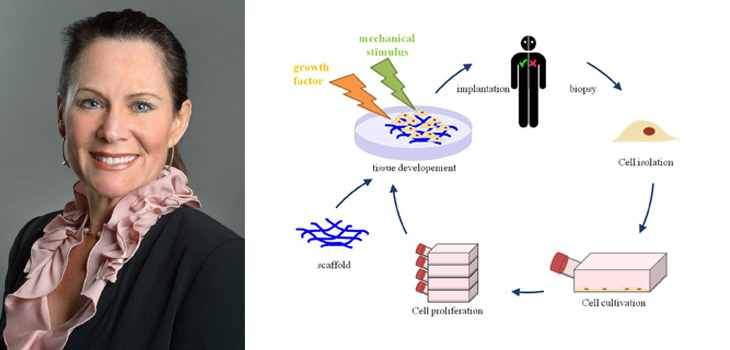
Dr. Loboa told OTW, “We are trying to implement industry standard manufacturing approaches used in textiles to create scaffolds for tissue engineering applications. Such applications could include regeneration and repair of musculoskeletal tissues.”
As indicated in the April 14, 2016 news release, “In typical tissue engineering approaches that use fibers as scaffolds, nonwoven materials are often bonded together using an electrostatic field. This process, called electrospinning, creates the scaffolds needed to attach to stem cells; however, large-scale production is not cost-effective.”
“Electrospinning produces weak fibers, scaffolds that are not consistent and have pores that are too small, ” Dr. Loboa said. “We can run our system for hours and create about a ten-inch diameter of scaffold material. Therefore, we sought to test methods that could standardize the process. The goal of ‘scaling up’ is to produce hundreds of meters of material that look the same, have the same properties and can be used in clinical settings. So, we investigated the processes that create textiles, such as clothing and window furnishings like drapery, to scale up the manufacturing process.”
According to the news release, “Dr. Loboa worked with Stephen A. Tuin, a recent doctoral graduate from her research group at the Joint Department of Biomedical Engineering at the University of North Carolina and North Carolina State University (NCSU), and Behnam Pourdeyhimi of the NCSU College of Textiles. The group published a pair of papers using three common textile creation methods—meltblowing, spunbonding and carding—to determine if these methods would create the materials needed to mimic native tissue.”
“Meltblowing is a technique during which nonwoven materials are created using a molten polymer to create continuous fibers. Spunbond materials are made much the same way but the fibers are drawn into a web while in a solid state instead of a molten one. Carding involves the separation of fibers through the use of rollers, forming the web needed to hold stem cells in place.”
“Loboa and her colleagues tested these techniques to create polylactic acid (PLA) scaffolds, a Food and Drug Administration-approved material used as collagen fillers, seeded with human stem cells. They then spent three weeks studying whether the stem cells remained healthy and if they began to differentiate into fat and bone pathways, which is the goal of using stem cells in a clinical setting when new bone and/or new fat tissue is needed at a defect site. Results showed that the three textile manufacturing methods proved as viable if not more so than electrospinning.”
“These alternative methods are more cost-effective than electrospinning, ” Dr. Loboa said. “A small sample of electrospun material could cost between $2 to $5. The cost for the three manufacturing methods is between $.30 to $3.00; these methods proved to be effective and efficient. Next steps include testing how the different scaffolds created in the three methods perform once implanted in animals.”
Author
React:
Discussion
This is a fascinating development. In my practice we've seen similar outcomes with the revised protocol. The key differentiator seems to be patient selection criteria. Has anyone else noticed the correlation with BMI thresholds?
Great point. I'd push back slightly on the conclusion, the sample size in the cited study is too small to draw population-level inferences. That said, the directional signal is compelling and worth a larger RCT.
We implemented a similar approach last year. Early results are promising but we're still gathering 12-month follow-up data. Happy to share our protocol if anyone is interested.
Join the conversation
Orthopedic professionals are discussing this. Sign in and upgrade to read every comment and add your voice.