
In an effort to harmonize the dual goals of protecting and promoting public health, the FDA wants to expedite the generation and dissemination of reliable device data, including real-world evidence.
FDA’s New Device Evaluation System
2 min read Premium comments
Secondary
To accomplish this, the agency and the Brookings Center for Health Policy convened a planning board in 2014 made up of patients, clinicians, researchers, provider organizations, health plans, industry, experts in health information systems and key government agencies like the National Institutes of Health and the Centers for Medicare and Medicaid Services (CMS). In late 2015, the FDA asked the Duke-Margolis Center for Health Policy to help lead that effort.
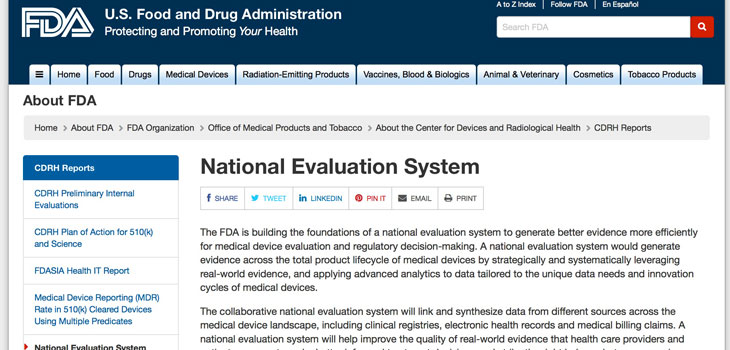
National Medical Device Evaluation System
This national medical device evaluation system (NMDES) board released a report on April 4, 2016 outlining how it plans to develop such a system as well as creating a center to coordinate such efforts.
According to a Regulatory Affairs Professional Society (RAPS) posting, the report envisions a network of voluntary partnerships of device makers, government agencies, patients and others working together to “generate higher quality data and evidence at lower costs to inform and improve patient care.”
Resources in the evaluation system would include:
- Data from multiple sources (including electronic health records, claims, registries, patient reported outcomes, clinical trial data, etc.) connected through re-usable, standardized data use agreements that optimize data standardization, expedite project-specific research agreements, and reduce the cost of evidence development through economies of scale
- A clearinghouse of expertise and advanced methods, tools, standards and best practices (e.g., to detect safety events and to study clinical effectiveness of new technologies for regulatory and reimbursement decisions)
- A trusted and up-to-date compilation of reliable information on the benefits and risks of medical devices for patients and the broader health community (e.g., safety updates, recall management support, emerging effectiveness information)
The report adds that the system would constantly identify “new sources of reliable device data and design and implement innovative ways of capturing and combining data from disparate sources while ensuring that federal patient-privacy laws, regulations and ethical standards are maintained.”
Industry Impact
The report also says that industry should like this because the NMDES would be expected to complement the iterative nature of device development and give manufacturers a faster, more predictable path to approval and reimbursement decisions.
Once products are on the market, NMDES would also provide more cost-effective approaches to developing postmarket evidence, leading to greater confidence among clinicians in the products they use and recommend. Meanwhile, payers would benefit from having better evidence to help make coverage decisions.
To read more details about the FDA’s device evaluation system, as well as the report itself, click here.
Author
React:
Discussion
This is a fascinating development. In my practice we've seen similar outcomes with the revised protocol. The key differentiator seems to be patient selection criteria. Has anyone else noticed the correlation with BMI thresholds?
Great point. I'd push back slightly on the conclusion, the sample size in the cited study is too small to draw population-level inferences. That said, the directional signal is compelling and worth a larger RCT.
We implemented a similar approach last year. Early results are promising but we're still gathering 12-month follow-up data. Happy to share our protocol if anyone is interested.
Join the conversation
Orthopedic professionals are discussing this. Sign in and upgrade to read every comment and add your voice.