
As Wells Fargo senior analyst Larry Biegelsen reported at the end of March, FDA PMA (pre-market approval) performance is at an all-time high for approvals and speed of reviews.
FDA’s 510(k) Clearance Performance Remains Average
2 min read Premium comments
Secondary
But in an April 8, 2016 report, Biegelsen and his team found that the agency’s performance with 510(k) clearance trends isn’t quite as good.
Less expensive 510(k) clearances are usually granted for lower risk devices, while costly PMA approvals are granted for higher risk devices. If a manufacturer can show that his or her device is substantially equivalent to a previously approved device, the manufacturer can then seek 510(k) clearance. The incremental progress of the substantially equivalent strategy has been the pathway of choice for device makers.
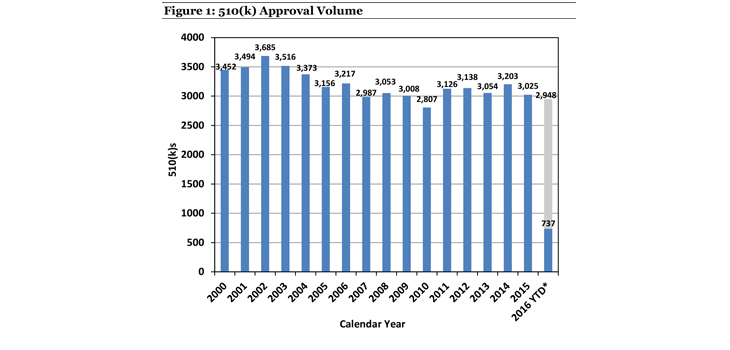
Biegelsen’s team found that in 2015 the number of 510(k)s found to be substantially equivalent by the FDA was roughly 6% below 2014 levels, although 2015 510(k) clearance volume is essentially in-line with its historical five-year average. They also found 510(k) submission volume declined in fiscal year (FY) 2015 (October – September) and appears to be below trend through the first quarter of 2016.
Innovation Environment Is Healthy
The average 510(k) review time and percentage of 510(k)s that were found to be substantially equivalent in FY 2015 showed improvements over FY 2014 levels. “Although recent 510(k) approval [clearance] and submission volume has declined modestly, we view the faster FDA review times and increased approval [clearance] rates as indicators that the regulatory environment remains healthy and conducive to device innovation.”
According to the Wells Fargo analysis, 3, 025 510(k)s were determined to be substantially equivalent by FDA in 2015. The 2015 volume represents a 6% decline vs. 2014, but remains essentially in-line with its previous five-year average. 510(k) activity in 2016 (through March) is 2% ahead of 2015’s pace and a few percentage points below the 2011-2015 average (over the same time period). On a pro-rated basis, current 2016 approval volume is -2.5% below full year 2015 levels.
In FY 2015, the FDA received a total of 3, 725 510(k) submissions, which is below FY 2014 and FY 2013 levels of 3, 765 and 4, 020 submissions, respectively. On a pro-rated basis, current FY 2016 volume is 6% below FY 2015. Biegelsen writes that the cause of the decline in submission volume is unclear to his team. The FY 2015 510(k) clearance rate of 85% represents a slight improvement in the percentage of 510(k)s found substantially equivalent, up from 84% in FY 2014 and 79% in FY 2013.
Author
React:
Discussion
This is a fascinating development. In my practice we've seen similar outcomes with the revised protocol. The key differentiator seems to be patient selection criteria. Has anyone else noticed the correlation with BMI thresholds?
Great point. I'd push back slightly on the conclusion, the sample size in the cited study is too small to draw population-level inferences. That said, the directional signal is compelling and worth a larger RCT.
We implemented a similar approach last year. Early results are promising but we're still gathering 12-month follow-up data. Happy to share our protocol if anyone is interested.
Join the conversation
Orthopedic professionals are discussing this. Sign in and upgrade to read every comment and add your voice.