
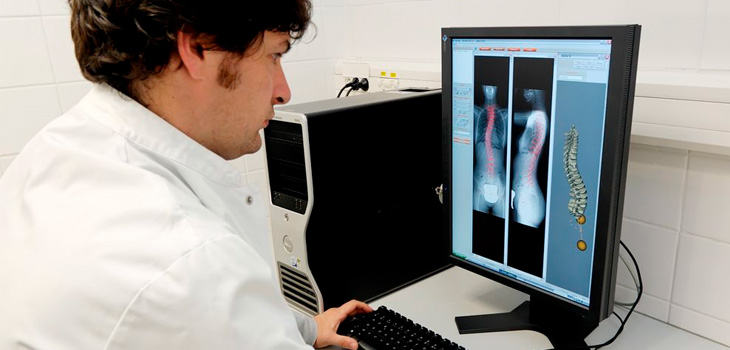
EOS imaging has announced that the FDA has approved spineEOS, an online 3D planning software for spine surgery based on EOS stereo-radiographic 2D/3D imaging. This approval, says the company, is especially important for expanding its presence in the complex spine and thoracolumbar fusion surgery markets. The planning software is intended for adults suffering from degenerative or deformative spine conditions, as well as for pediatric patients with adolescent idiopathic scoliosis.
FDA Approval for EOS’ spineEOS
1 min read Premium comments
Secondary
According to the April 12, 2016 news release, “It allows a surgeon to create a treatment plan to achieve optimal sagittal alignment from pelvic and vertebral 3D data obtained in the functional standing position from an EOS exam. The planned surgery and virtual post-correction 3D anatomy can be used to precisely plan for the 3D shape and length of the spinal implants. It can also be shared pre-operatively to engage the patient in the intended course of therapy, and is accessible in the operating room through a custom planning report.”
Marie Meynadier, Ph.D., CEO of EOS imaging, said, “We believe that patients’ spines are complex 3D systems that need a personalized 3D planning of the intended surgery. We’re excited about the interest we’ve seen in our spineEOS planning software from surgeons inside and outside of our current installed base, as well as from our industry partners. We look forward to this next important step toward our broader goal of expanding our EOSapps planning software suite to better connect imaging to patient care.”
Marie Meynadier told OTW, “spineEOS allows both automated and manual virtual realignment of the pelvis and vertebrae from their 3D shape and pre-op position in 3D space. All key clinical parameters are displayed in real time and compared to published normality corridors.”
React:
Discussion
This is a fascinating development. In my practice we've seen similar outcomes with the revised protocol. The key differentiator seems to be patient selection criteria. Has anyone else noticed the correlation with BMI thresholds?
Great point. I'd push back slightly on the conclusion, the sample size in the cited study is too small to draw population-level inferences. That said, the directional signal is compelling and worth a larger RCT.
We implemented a similar approach last year. Early results are promising but we're still gathering 12-month follow-up data. Happy to share our protocol if anyone is interested.
Join the conversation
Orthopedic professionals are discussing this. Sign in and upgrade to read every comment and add your voice.