
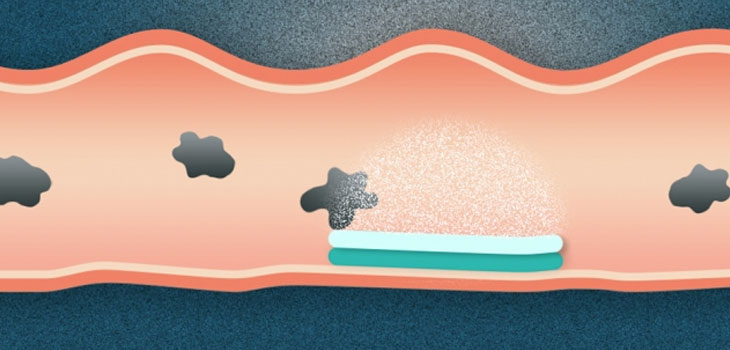
One side is sticky…the other repels. In a stroke of novelty, researchers from MIT and Brigham and Women’s Hospital have designed an interesting pill that can attach to the lining of the gastrointestinal (GI) tract and slowly release its contents. The opposite side of the pill repels food and liquids that would otherwise pull it away from the attachment site. The pill is called a Janus device after the two-faced Roman god.
Dual-Sided Pill From MIT
2 min read Premium comments
Secondary
“This could be adapted to many drugs. Any drug that is dosed frequently could be amenable to this kind of system, ” says Giovanni Traverso, M.D., Ph.D. in the April 6, 2016 news release. Traverso is a research affiliate at MIT’s Koch Institute for Integrative Cancer Research, a gastroenterologist at Brigham and Women’s Hospital, and one of the senior authors on the paper.
As indicated in the news release, “Such extended-release pills could be used to reduce the dosage frequency of some drugs, the researchers say. For example, antibiotics that normally have to be taken two or three times a day could be given just once, making it easier for patients to stick to their dosing schedule.”
“For the mucoadhesive side, the researchers used a commercially available polymer known as Carbopol, which is often used industrially as a stabilizing or thickening agent. The omniphobic side consists of cellulose acetate that the researchers textured so that its surface would mimic that of a lotus leaf, which has micro and nanoscale protrusions that make it extremely hydrophobic. They then fluorinated and lubricated the surface, making it repel nearly any material.”
“The researchers used a pill presser to combine the polymers into two-sided tablets, which can be formed in many shape and sizes. Drugs can be either embedded within the cellulose acetate layer or placed between the two layers.”
“To simulate the tumultuous environment of the GI tract, the researchers flowed a mix of food including liquids and small pieces of bread and rice along the tissue and then added the tablets. The dual-sided omniphobic tablet took less than 1 second to travel along the tissue, and the dual-sided mucoadhesive stuck to the tissue for only 7 seconds before being pulled off. The Janus version stayed attached for the length of the experiment, about 10 minutes.”
Traverso told OTW, “The biggest challenge was generating a system that was made of materials compatible with drug loading and also included mucoadhesive and omniphobic surfaces all in one.”
“Although these systems were developed with the gastrointestinal tract, Janus systems such as the one we developed may serve as a good protective bandage which may be applied by surgeons. As a bandage, the mucoadhesive layer could be used to adhere to the wound and the omniphobic layer to repel any external debris to minimize the risk of infection.”
React:
Discussion
This is a fascinating development. In my practice we've seen similar outcomes with the revised protocol. The key differentiator seems to be patient selection criteria. Has anyone else noticed the correlation with BMI thresholds?
Great point. I'd push back slightly on the conclusion, the sample size in the cited study is too small to draw population-level inferences. That said, the directional signal is compelling and worth a larger RCT.
We implemented a similar approach last year. Early results are promising but we're still gathering 12-month follow-up data. Happy to share our protocol if anyone is interested.
Join the conversation
Orthopedic professionals are discussing this. Sign in and upgrade to read every comment and add your voice.