
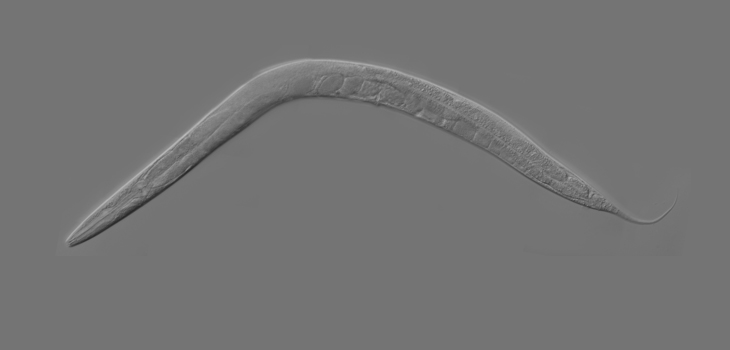
Researchers from Boston University School of Medicine (BUSM) have found a new pathway leading to the regeneration of central nervous system (CNS) brain cells in a roundworm (C. elegans), a discovery that can help us understand the adult human nervous system’s ability to regenerate and ultimately make progress with spinal cord injury and paralysis.
Cell Regeneration in Roundworm Elucidates Human Nervous System
2 min read Premium comments
Secondary
BUSM researcher and corresponding author Christopher V. Gabel, Ph.D. explained in the April 11, 2016 news release, “We describe a new type of neuron regeneration in C. elegans that is independent of previously discovered regeneration pathways. This is experimentally much more accessible and will allow us to study regeneration much more rapidly than before.” This regeneration in C. elegans is related to a type of regeneration that occurs in the CNS of mammals.
“At the end of development, neurons in the adult human CNS, such as the brain and spinal cord, lose their ability to effectively regenerate in response to injury, ” explained Gabel, assistant professor of physiology and biophysics at BUSM. This is why permanent damage and paralysis typically follow CNS injury. “But, when two lesions are made to the same neuron, remarkably, some cells in the human CNS robustly regenerate—a phenomenon known as lesion conditioning and which was strikingly similar to what we saw in our experiments with C. elegans.”
Gabel expects that his team, led by lead author Samuel Chung, Ph.D., will be able to identify the genes contributing to this effect and envisions that C. elegans can be used as a model to study CNS regeneration in mammals.
Dr. Gabel told OTW, “The key challenge of this study was the isolation of a new neuro-regenerative pathway in C. elegans, a microscopic nematode or roundworm. Using precise laser damage to a particular neuron type, we could observe this novel form of regeneration that appears to be related to a robust form of regeneration in the mammalian central nervous system. The ability to study this process in the simple worm will accelerate the rate of discovery in this area.”
“Ultimately our findings could lead to improved neuronal recovery following traumatic damage and surgery. Neurons possess an innate ability to regenerate, which declines in mammals as the animal reaches maturity. Our research is working to unlock this potential to improve neurotherapeutics.”
React:
Discussion
This is a fascinating development. In my practice we've seen similar outcomes with the revised protocol. The key differentiator seems to be patient selection criteria. Has anyone else noticed the correlation with BMI thresholds?
Great point. I'd push back slightly on the conclusion, the sample size in the cited study is too small to draw population-level inferences. That said, the directional signal is compelling and worth a larger RCT.
We implemented a similar approach last year. Early results are promising but we're still gathering 12-month follow-up data. Happy to share our protocol if anyone is interested.
Join the conversation
Orthopedic professionals are discussing this. Sign in and upgrade to read every comment and add your voice.