
Zimmer Biomet Holdings, Inc. has launched three new hip portfolio products which promise to conserve natural bone, add new sizes and offer the benefit of dislocation resistance.
Zimmer Biomet Hip Portfolio Grows by Three
2 min read Premium comments
Secondary
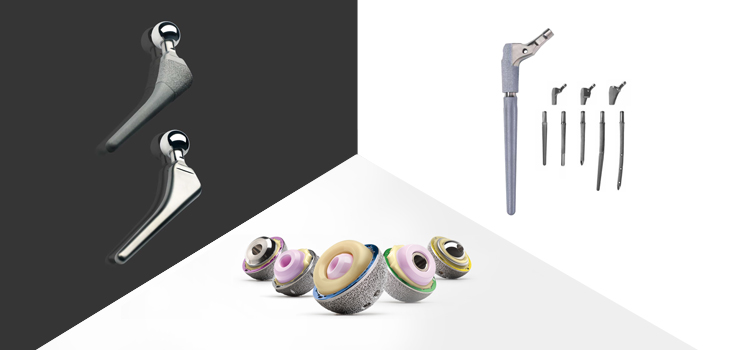
The products, announced on March 2, 2016, are the Echo Bi-Metric Microplasty stem femoral prosthesis, the G7 Dual Mobility Construct and the Arcos One-Piece Femoral.
Echo Bi-Metric Microplasty Stem
According to the company, the Echo stem is a “metaphyseal loading, fit-and-fill femoral prosthesis implanted through a simple, broach-only surgical technique.” The stem is based on the “clinically proven” Bi-Metric family of hip prostheses and is approximately 30% shorter than the full-length Echo Bi-Metric stem, conserving more of the patient’s natural bone and enabling the use of minimally invasive surgical approaches.
G7 Dual Mobility Construct
The G7 Dual Mobility Construct, claims the company, “offers surgeons the benefit of dislocation resistance without the need to constrain the femoral head, combining stability and high range of motion for a variety of patient indications.” The addition of the G7 expands the company’s portfolio of shell, fixation and bearing options within the G7 Acetabular System, which, the company says, “enables surgeons to personalize implant selection and establish a stable joint in total hip arthroplasty.” The G7 system also claims a streamlined instrumentation and delivery platform.
Arcos One-Piece Femoral Revision System
The Arcos One-Piece Femoral Revision system offers three fully porous, titanium stem options with a range of sizes that can address small femora. The system “builds on the clinical success of the Arcos Modular System launched in 2010, and offers the same popular stem geometry, intuitive instrumentation and straightforward surgical technique, ” stated the company announcement.
Jim Lancaster, head of the company’s global hip business, said, “The Zimmer Biomet Hip portfolio is the most comprehensive on the market, and these exciting product introductions represent our strength and commitment to expanding our offerings through our passion and dedication to efficient product development and launch. The healthcare environment is rapidly changing, and we remain focused on the timely introduction of clinically relevant, cost-effective solutions that meet the individual needs of patients, surgeons and hospitals around the world.”
The launches coincided with the 2016 annual meeting of the American Academy of Orthopaedic Surgeons held in Orland, Florida.
Author
React:
Discussion
This is a fascinating development. In my practice we've seen similar outcomes with the revised protocol. The key differentiator seems to be patient selection criteria. Has anyone else noticed the correlation with BMI thresholds?
Great point. I'd push back slightly on the conclusion, the sample size in the cited study is too small to draw population-level inferences. That said, the directional signal is compelling and worth a larger RCT.
We implemented a similar approach last year. Early results are promising but we're still gathering 12-month follow-up data. Happy to share our protocol if anyone is interested.
Join the conversation
Orthopedic professionals are discussing this. Sign in and upgrade to read every comment and add your voice.