
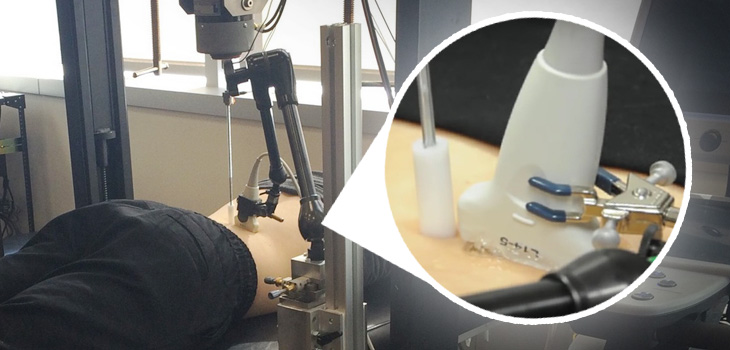
Spines are vibrating in Canada, as new research from the University of Alberta has found that back pain can be evaluated using vibration. The team, led by Greg Kawchuk, Ph.D., worked with the University of Southern Denmark to study the lumbar spines of twins.
Vibration Helps Evaluate Back Pain
2 min read Premium comments
Secondary
“Instead of using large seismic vibrations to find oil, we used gentle vibrations to find out where problems exist in the back, ” explained Dr. Kawchuk in the March 11, 2016 news release. Dr. Kawchuk, professor of physical therapy at the University of Alberta’s Faculty of Rehabilitation Medicine, added, “By studying and testing vibration responses in identical twins, we were able to demonstrate that structural changes within the spine alter its vibration response.”
According to the news release, “…In instances where twins had similar spines, the vibration responses were statistically similar. But if one twin had a different spine (due to an accident or injury for example), the vibration responses were significantly different.”
“In Denmark we have the world’s largest and most comprehensive twin registry and using this unique resource, we have been able to contribute to research that can potentially help to diagnose millions of back pain patients, ” added Jan Hartvigsen, professor of clinical biomechanics and musculoskeletal research, University of South Denmark.
Dr. Kawchuk told OTW, “Our original papers exploring this concept were published in Journal of Biomechanics. Here, we used an invasive approach to attach the vibration unit and sensors to the spines of cadavers. Of course, that approach is not feasible for clinical applications. That challenge has been to create a non-invasive way to extract the same data.”
“When it comes to assessing the function of the spine, we have very few tests that are objective and relate to patient symptoms. To fill that gap, we looked toward engineering tests used to assess mechanical structures. The challenge has been to adapt those tests for use in human subjects.”
“Maybe this is not true of all twins, but the ones we tested were super competitive! They always wanted to know if their signals were ‘better’ than their sibling’s.”
“Now that we have a proof of concept, the next step will be a large trial to evaluate the clinical impact of the technology.”
React:
Discussion
This is a fascinating development. In my practice we've seen similar outcomes with the revised protocol. The key differentiator seems to be patient selection criteria. Has anyone else noticed the correlation with BMI thresholds?
Great point. I'd push back slightly on the conclusion, the sample size in the cited study is too small to draw population-level inferences. That said, the directional signal is compelling and worth a larger RCT.
We implemented a similar approach last year. Early results are promising but we're still gathering 12-month follow-up data. Happy to share our protocol if anyone is interested.
Join the conversation
Orthopedic professionals are discussing this. Sign in and upgrade to read every comment and add your voice.