
Now they can really get to work! A group of talented researchers from Thomas Jefferson University (TJU) and the Rothman Institute have been named as the first teams selected to participate in the Entrepreneurs-in-Residence program (EIR) that is part of the Independence Blue Cross/Jefferson Health Innovation Collaboration announced last June.
TJU, IBC Select Entrepreneurs-in-Residence
2 min read Premium comments
Secondary
Each of the two teams will receive $150, 000 to support projects that will address two important health issues: bone graft and joint replacement infection and advanced surgical treatment of complex epilepsy.
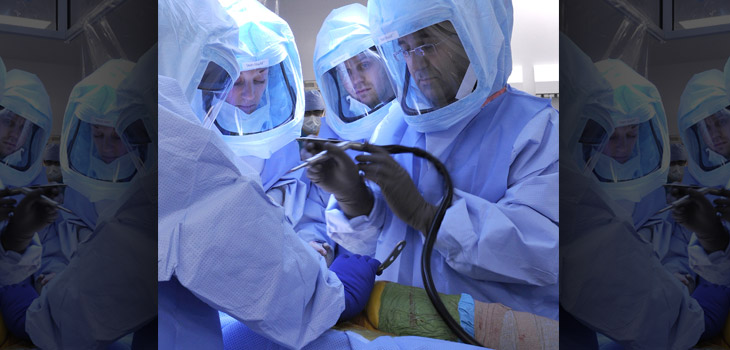
According to the March 2, 2016 news release, “TJU researchers Noreen Hickok, Ph.D. and Irving Shapiro, Ph.D. and Rothman Institute orthopedic surgeon Jay Parvizi, M.D. will use their funds to pursue promising new ways to make a longer-lasting antibiotic coating for use in bone grafts of donated tissue and replacement joints for orthopedic surgeries. Bone infections are difficult to treat.”
“The second Entrepreneur-in-Residence is Ashwini Sharan, M.D., a neurosurgeon at Thomas Jefferson University Hospital who specializes in surgery for patients whose epilepsy does not respond to medication. Dr. Sharan is pioneering techniques to more specifically identify and treat areas in the brain that cause seizures.”
“The Independence/Jefferson Collaboration is engaged in a unique kind of disruption, ” said Stephen K. Klasko, M.D., MBA, president and CEO of TJU and Jefferson Health. “When an insurer and a health system jointly support an enterprise that can benefit patient care, we know we are onto something big.”
“We are fortunate to have this group of talented and highly motivated medical experts as our first Entrepreneurs-in-Residence, ” said Daniel J. Hilferty, president and CEO of Independence Blue Cross. “Improving the treatment of epilepsy and preventing infections and unnecessary pain and hospitalizations for patients who have had bone grafts or joint replacement is a huge step forward for medicine, and one that we are very proud to help through our Innovation Collaboration.”
“The Collaboration’s Entrepreneurs-in-Residence program represents an important new way of thinking about how to harness clinical and research creativity and move it to a higher stage of development for future applications in real-time patient care, ” said Donna Gentile O’Donnell, Ph.D., who led the development of the Collaboration.
Dr. Parvizi told OTW, “This collaborative research is likely to lead to generation of bone grafts that resist infection. The first out of the gate will be testing the bone grafts in an animal model that we have developed at Jefferson. If proven to be effective, which we expect will be, then we will work with one of the main allograft procurement companies to generate infection resistant allograft bone.”
“This will be a great accomplishment. The bone grafts are usually used in patients with bone loss and complex issues. These patients are at higher risk of infection in the first instance. The tethered bone grafts will allow surgeons to deal with these complex issues while minimizing the risk of infection.”
React:
Discussion
This is a fascinating development. In my practice we've seen similar outcomes with the revised protocol. The key differentiator seems to be patient selection criteria. Has anyone else noticed the correlation with BMI thresholds?
Great point. I'd push back slightly on the conclusion, the sample size in the cited study is too small to draw population-level inferences. That said, the directional signal is compelling and worth a larger RCT.
We implemented a similar approach last year. Early results are promising but we're still gathering 12-month follow-up data. Happy to share our protocol if anyone is interested.
Join the conversation
Orthopedic professionals are discussing this. Sign in and upgrade to read every comment and add your voice.