
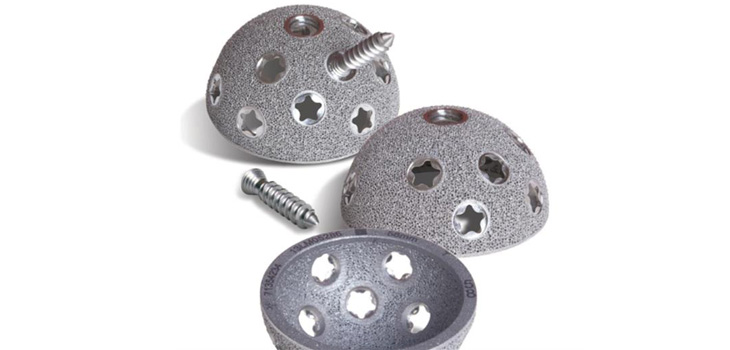
The Smith & Nephew booth was sporting a new acetabular cup at the recent American Academy of Orthopaedic Surgeons (AAOS) meeting in Orlando. Known as the REDAPT Revision Acetabular Fully Porous Cup with CONCELOC Technology, according to the March 1, 2016 news release, this cup is meant for revision cases where compromised bone makes implant fixation and stability more difficult. “To allow ingrowth, an additive, or #D, manufacturing process is used to produce an entirely porous implant that mimics the structure of cancellous bone and new variable-angle locking screws can be used to enhance implant stability and minimize micromotion after surgery.”
Smith & Nephew Launches New Acetabular Cup
1 min read Premium comments
Secondary
“The CONCELOC Advanced Porous Titanium technology is an alternative to external porous coatings, such as sintered beads or fiber mesh used in other uncemented implants, to allow bone ingrowth securing the implant in place.”
“This fully porous cup gives surgeons flexibility in ways that simply weren’t possible before, ” said Craig Della Valle, M.D., Professor of Orthopaedic Surgery at Rush University Medical Center in Chicago, who participated on the surgeon design team for the new REDAPT Cup. “The locking screws, screw-in trials, purpose-built liners and screw hole patterns optimized for hard-to-access areas really set it apart during a revision procedure. This cup builds on good technology and turns it into something spectacular.”
Mike Donoghue, vice president of Global Reconstruction at Smith & Nephew, told OTW, “As a result of our advancements in 3D printing technology, we can deliver to our customers the unique combination of a porous body implant with solid structures. This exciting technology serves the needs of our customers who perform difficult revision hip surgery.”
React:
Discussion
This is a fascinating development. In my practice we've seen similar outcomes with the revised protocol. The key differentiator seems to be patient selection criteria. Has anyone else noticed the correlation with BMI thresholds?
Great point. I'd push back slightly on the conclusion, the sample size in the cited study is too small to draw population-level inferences. That said, the directional signal is compelling and worth a larger RCT.
We implemented a similar approach last year. Early results are promising but we're still gathering 12-month follow-up data. Happy to share our protocol if anyone is interested.
Join the conversation
Orthopedic professionals are discussing this. Sign in and upgrade to read every comment and add your voice.