
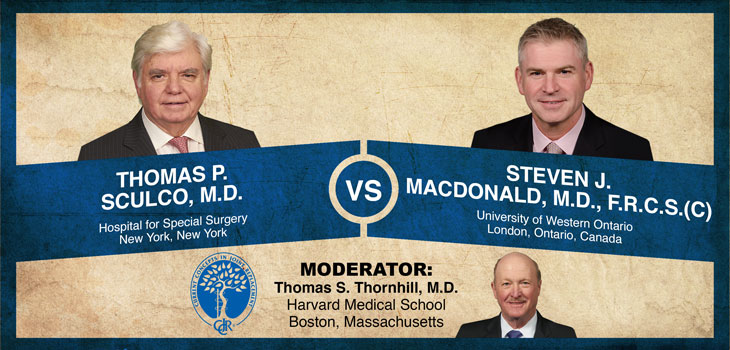
This week’s Orthopaedic Crossfire® debate was part of the 32nd Annual Current Concepts in Joint Replacement® (CCJR) – Winter meeting, which took place in Orlando this past December. This week’s topic is “Dual Mobility: An “Every Man’s” Choice for Primary THA.” For the proposition is Thomas P. Sculco, M.D., Hospital for Special Surgery, New York, New York. Opposing is Steven J. MacDonald, M.D., F.R.C.S.(C), University of Western Ontario, London, Ontario, Canada. Moderating is Thomas S. Thornhill, M.D., Harvard Medical School, Boston, Massachusetts.
Sculco v. MacDonald: Dual Mobility: An “Every Man’s” Choice for Primary THA
8 min read Premium comments
Great Debates
Dr. Sculco: Dual mobility is not a new concept. It embodies the Charnley concept of low friction arthroplasty and the Mueller or McKee-Farrar concept of using a larger femoral head for stability. In Europe there are many, many different types of dual mobility prostheses through the years and the rationale for its use is that it reduces dislocation in high risk primary and revision total hip replacement patients. In the registry data, dislocation is sometimes the first or second cause of revision. So, we have a problem in this area.
What the dual mobility, in its current design, provides is anatomic laterality.
The femoral head is incorporated into the polyethylene liner using a vise assembly techniqueand provides improved hip stability because of the constraint of the femoral head. Also the polyethylene liner, the larger liner, becomes essentially a larger femoral head and the jump distance therefore is increased before dislocation can occur.
Dual mobility also improves hip stability because of an increase in the head/neck ratio. Because the head is now the liner it is somewhat more difficult for it to jump out and dislocate. As a result, the patient can have an excellent range of motion and reduced impingement.
Now there are disadvantages. This is essentially a monoblock socket and you’ve got to be comfortable with a monoblock concept which means that the acetabular floor is not visualized during implantation. Additionally, there is a risk of intraprosthetic dislocation where the femoral head dislocates from the polyethylene liner. That, in turn, raises the question of two articulating surfaces and increased wear.
The motion occurs primarily at the inner bearing of the smaller femoral head and the polyethylene liner and that leads to improved wear properties as Charnley demonstrated so many years ago. In a study of 40 retrieved sockets (Rev Chir Orthop Reparatrice, 2005), the data does show that most of the wear occurs at the inner bearing and is quite acceptable.
Now what are the indications for use? In my hands, I use it for patients who have increased risk of dislocation. Patients with neuromuscular disease and certain revision settings – acute hip fractures and chronic steroid use where the soft tissues are not good. Additionally, patients with hyperlaxity.
What are the results? There are a number of long-term studies out there. A study from France (Phillippot et al) —384 dual mobility cups, no dislocations, socket survival at 15 years at 94%—intraprosthetic dislocation was a problem in this series (4%). But essentially the long-term follow-up was quite good in this series.
Another 22-year follow-up study from Europe (Boyer et al, ) —240 dual mobility sockets, using an older socket design, no dislocations, but 41 revisions primarily due to loosening of that socket, tending to intraprosthetic dislocations and a 74% survivorship. Taraservius et al. reported a femoral fracture series—56 conventional hips in which they had eight dislocations and 42 dual mobility cups with 0 dislocations.
Our experience at HSS to date—810 dual mobility cups have been implanted for about just beyond five years and we’ve had six dislocations and three revisions. My personal series—237 of these, one dislocation to date and one revision. The population is mostly older females.
In summary, I think the dual mobility cup does improve stability in the high risk patient. I think the fixation is improved with new cup designs and highly crossinked polyethylene may, in fact, lessen the intraprosthetic problems that we’ve seen with the earlier designs.
Dr. MacDonald: When you think about dual mobility, it really is as Tom mentioned, a monoblock shell, large poly, smaller head, mated to a stem. That was used in Europe for many, many years. In North America this implant is a modular shell with a metal insert and has the same polyethylene and femoral head.
First off, does the concept make sense? In a differential hardness bearing, which we’re talking about here, the harder surface is normally articulating against the softer surface. So if you think about a total hip arthroplasty construct, the harder surface—that being metal or ceramic—articulates against a softer surface—that being polyethylene. Why is that? Well, when you reverse the situation, you actually get increased wear. So again, hard on soft, we have a track record with. Soft on hard, not so much, and in the lab is counterintuitive.
There’s not a lot of basic science to review. That’s helpful in one sense. One paper (Loving et al, 2013) showed that dual mobility wore 75% less than a single articulating bearing. So you think, ‘That’s pretty good.’ Except for the fact that one was highly cross-linked and one was conventional polyethylene, so that’s really not a fair comparison.
So if you look at the design, what are some of the other concerns? The poly is free to go into a more closed position. That could lead to edge loading and poly failure, but to date there haven’t been reports about that. We do have two articulating polyethylene surfaces so intuitively we know that there is a potential for increased wear and osteolysis with that second surface.
So, why are we doing this? The claim is for improved range of motion and stability. And that’s really why anybody would do this construct. But we’ve had great basic science literature and clinical data now, to suggest that once you get to a 36mm head, give or take, the range of motion and stability of the hip construct is maximized. And further increasing of the head diameter doesn’t give you necessarily improved range of motion and stability.
Who is this bearing being recommended for? It’s unclear. If you grab a techniques manual, it’s says OA, RA, revisions, patients with dislocation risk. That’s everybody, right? I mean that doesn’t hone it down very much. So let’s assume increased stability is the goal. That’s why we’re going to do this.
A summary paper (Stulberg, 2010) that looked at the series published to date and it showed the risk of a dislocation with dual mobility is about 0.5%. Fair enough. We have many published reports in the literature that show similar rates of 0.5% – 1.0%. With conventional constructs probably the best data is Medicare data and it shows around a 2.0% dislocation rate.
So remember that number of 2.0%. Because there is a very important thing you need to understand and that’s this intraprosthetic dislocation risk. And you think, ‘Well, that’s probably pretty rare.’ Interestingly enough, it isn’t actually that rare. In this particular series (Hamadouche, et al.), it was 2.5% of all comers, and 7.5% if you used a long ball option. So you can say, ‘I’ll avoid that.’ Well how about this series of 2, 000 primary total hips (Philippot, et al.), not revisions is what we’re talking about, with a 4.0% incidence.
If we take conventional total hip and say worse-case scenario, you’ve got a 2.0% dislocation rate, you take dual mobility with a 0.4% dislocation rate of the poly on the insert, now start adding intraprosthetic dislocation rate—you know, I’m not a math major, but I don’t think that formula works out to the advantage of dual mobility.
What are some other concerns? One recent report (Matsen Ko, et al.) on a series of 100 patients—4 had pain and elevated metal ions; 2 had MARS MRI consistent with adverse local tissue response. To me, one of the most compelling things is the Australian registry now capturing dual mobility and there’s a difference—a 1.0% difference. We’re at five years, and we’re already approaching statistical significance with a higher cumulative revision rate with dual mobility. That’s concerning to me because we’ve seen these trends early on with slopes that all of sudden change.
So which patient should dual mobility implants be applied to? How about ones we don’t already have good answers for. That’s to manage recurrent instability in total hip arthroplasty where it performs very well—4.0% only re-revised for instability—and in a series (Hailer, et al.), very encouraging, 200 cases revised for instability with only 2.0% re-revised. That’s a good application.
So in summary, I think conceptually there are challenges. Dual mobility was introduced 40 years ago and we’ve learned a lot about various things in those 40 years, there are not enough mid- and long-term published reports and any new implants should show equivalence in wear, fixation, mid-term results, complications, costs—none of which dual mobility does in 2015. So I would say, today it’s an option for revision of total hip for instability, not primary total hip.
Moderator Thornhill: Tom, Steve was saying, ‘Well, look, you don’t have any…you can’t bottom ‘em out because it doesn’t have screws, so you make another cup that you put screws in.’ ‘It’s a cobalt chrome that doesn’t grow in as well as titanium, so you spray titanium on it.’ ‘The poly’s wearing so you change the poly.’ Do you have a two-handed strangle hold on a loser here?
Dr. Sculco: I do not think in any way that this is the replacement to use for primary hip replacement. I do think there is a role for it. I was very skeptical at the beginning, as Steve has pointed out, and I thought these patients had more pain. In fact, that has not been the case. I think there’s been an evolution in terms of the design and the materials, which have made the results, and I think the results will be better going forward. I think the biggest place for it in my hands, is my older female patients. That’s a higher risk population and it has worked extremely well in those patients.
Moderator Thornhill: So Steve, you would use this in a patient who had recurrent dislocation?
Dr. MacDonald: I personally don’t but the literature would support its use over a constrained liner in mid-term reports.
Moderator Thornhill: Steve, I think what you were suggesting in your sort of soft on hard analogy that you’re more concerned about the outer bearing of this. Is that correct?
Dr. MacDonald: The answer is I don’t know. I mean, yes, I’m concerned about the outer bearing and we need to start seeing more retrieved implants just to see how this is going to perform in terms of wear and oxidation, quite frankly. But I think the inner bearing has shown its earlier failure rate with the intraprosthetic dislocation. I think long-term we’ve got an outer bearing issue; short-term we already have an inner bearing issue.
Moderator Thornhill: Tom, have you ever had to go to a dual mobility when you were doing a conventional hip and you just couldn’t get the stability? Or do you make up your mind ahead of time?
Dr. Sculco: I usually make up my mind before, but I would not hesitate in any way to go to a dual mobility if that was an issue. I think it’s a great option to have in your tool case.
Moderator Thornhill: I congratulate you all.
Please visit www.CCJR.com to register for the 2016 CCJR Spring Meeting, May 22 – 25 in Las Vegas.
React:
Discussion
This is a fascinating development. In my practice we've seen similar outcomes with the revised protocol. The key differentiator seems to be patient selection criteria. Has anyone else noticed the correlation with BMI thresholds?
Great point. I'd push back slightly on the conclusion, the sample size in the cited study is too small to draw population-level inferences. That said, the directional signal is compelling and worth a larger RCT.
We implemented a similar approach last year. Early results are promising but we're still gathering 12-month follow-up data. Happy to share our protocol if anyone is interested.
Join the conversation
Orthopedic professionals are discussing this. Sign in and upgrade to read every comment and add your voice.