
The bad news: researchers from Spain have found that psoriasis results in loss of bone tissue. The good news: psoriasis and the related bone loss may be treated with drugs already on the market. The study was led by the Genes, Development and Disease Group, headed by Erwin Wagner, Ph.D. at the Spanish National Cancer Research Centre (CNIO).
Psoriasis Causes Bone Loss!
2 min read Premium comments
Secondary
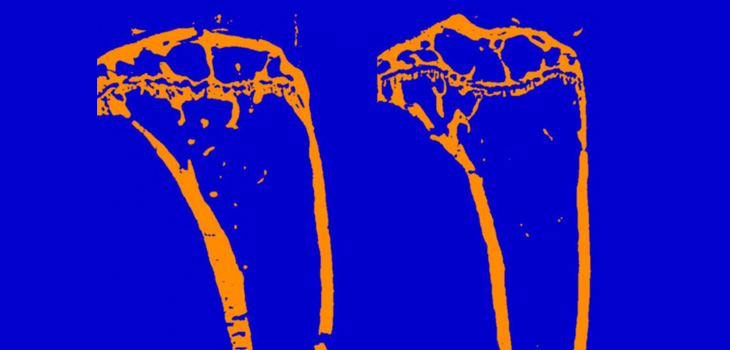
“We have detected that psoriasis causes the widespread and progressive loss of bone tissue, ” explained Özge Uluçkan, Ph.D., first author of the study, in the March 16, 2016 news release. “There is no active destruction of the bone; on the contrary, during the bone regeneration cycle, bone is not formed at the necessary speed to replace what is being lost and, therefore, patients’ bone mass reduces over time.”
As indicated in the news release, “The process takes place by means of a mechanism—unveiled in this study—that inhibits the activity of the osteoblasts, the cells that produce the bone matrix so that bones can grow during childhood and youth, and remain in good condition in adulthood.”
“In a previous study (Meixner et al., Nat Cell Biol, 2008), Erwin Wagner’s team generated a mouse model, from which they had removed the JunB gene in keratinocytes—cells that form the epidermis—mimicking what happens during cutaneous inflammatory disorders in humans. Now, they have observed that this mouse mutant suffers from bone loss. The researchers found that the immune cells in the skin of this animal model generated large amounts of the cytokine IL-17—a protein of the immune system that activates cellular inflammation in response to damage. IL-17 travels through the bloodstream to the bones. Once there, the protein acts on the osteoblasts and inhibits Wnt activity, which is a cellular signaling pathway that is involved in the formation of the skeleton and in certain disorders, such as osteoporosis, arthritis and myeloma. Treating these mice with IL-17 blockers allows the Wnt pathway to regain its normal activity and leads to bone formation. A second mouse model, induced by overexpression of IL-17 in skin, also shows bone loss, and suggests that the deregulation of the protein is sufficient to cause this effect.”
Dr. Uluçkan told OTW, “As bone is a tissue that is regulated by external cues, we examined bone health in patients with chronic skin inflammation without arthritic involvement. We used psoriasis patient samples and two mouse models of skin inflammation to study the effects of chronic skin inflammation on bone.”
“We found that psoriasis patients with no arthritic involvement presented with generalized bone loss that correlated with high serum IL-17A levels. It was interesting to see that the mechanism of bone loss was not through bone degradation by osteoclast activation. We demonstrated a decrease in osteoblast function with decreased bone formation markers in psoriasis patients as well as in two mouse models of skin inflammation.”
Author
React:
Discussion
This is a fascinating development. In my practice we've seen similar outcomes with the revised protocol. The key differentiator seems to be patient selection criteria. Has anyone else noticed the correlation with BMI thresholds?
Great point. I'd push back slightly on the conclusion, the sample size in the cited study is too small to draw population-level inferences. That said, the directional signal is compelling and worth a larger RCT.
We implemented a similar approach last year. Early results are promising but we're still gathering 12-month follow-up data. Happy to share our protocol if anyone is interested.
Join the conversation
Orthopedic professionals are discussing this. Sign in and upgrade to read every comment and add your voice.