
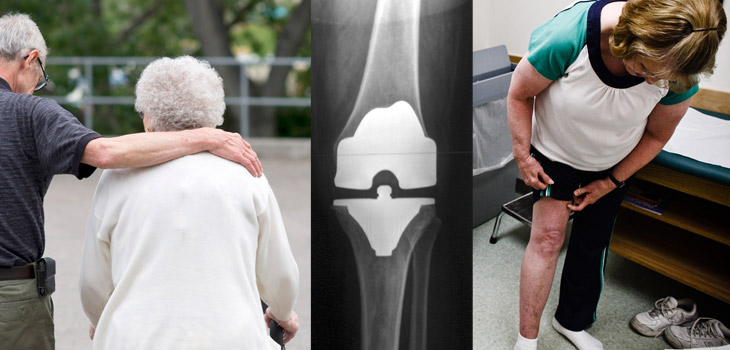
A new study has found that certain groups of patients fare worse when it comes to pain and activity following total knee replacement (TKR). Specifically, patients age 45 and younger, and those age 75 and older, report more pain and less activity after undergoing this procedure.
Older, Younger TKR Patients: More Pain, Less Activity
2 min read Premium comments
Secondary
“Knee replacement is a common, successful surgery in orthopaedics, ” said Randa Elmallah, M.D., lead study author and research fellow working under the supervision of Michael Mont, M.D., at Sinai Hospital’s Rubin Institute in Baltimore, in the March 1, 2016 news release.
As indicated in the news release, “In this study, researchers post-operatively reviewed the progress of 278 patients (108 men and 170 women) from seven medical institutions according to five age groups: 45 years and under, ages 45 to 54, 55 to 64, 65 to 74, and 75 years and older. Patients rated their status before the procedure and at different intervals after surgery—range of motion, pain, and activity levels associated with everyday tasks—for up to seven years using several common assessment tools: the Knee Society Scoring system (KSS), Short Form Health Survey (SF-36) and the lower extremity activity scale (LEAS).”
“All age groups reported improvements in range of motion following surgery, with no significant differences between age groups. In addition: Patients age 75 and older reported greater pain at six weeks and one year after surgery. The 75 and older and under 45 age groups reported the lowest activity scores at three months, and at five and seven years following surgery. At two years post-surgery, patients age 45 to 74 had significantly higher function scores than the 75 and older group and the under 45 group. Scores measuring functional health and wellbeing were lowest for patients age 45 and younger.”
“Our study points out that surgeons need to thoroughly discuss and manage patient’s expectations and recovery, particularly with patients at either end of the age spectrum, ” said Dr. Mont.
Asked about the most difficult expectation for doctors to manage, Dr. Mont told OTW, “This is often patient-specific and it is difficult to pinpoint one expectation—but these are often related to length of stay, healing rates, and most importantly time to ambulation/regain of full function.”
Author
React:
Discussion
This is a fascinating development. In my practice we've seen similar outcomes with the revised protocol. The key differentiator seems to be patient selection criteria. Has anyone else noticed the correlation with BMI thresholds?
Great point. I'd push back slightly on the conclusion, the sample size in the cited study is too small to draw population-level inferences. That said, the directional signal is compelling and worth a larger RCT.
We implemented a similar approach last year. Early results are promising but we're still gathering 12-month follow-up data. Happy to share our protocol if anyone is interested.
Join the conversation
Orthopedic professionals are discussing this. Sign in and upgrade to read every comment and add your voice.