
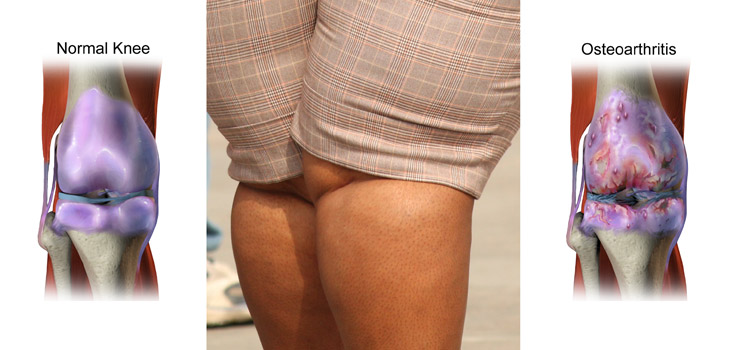
Researchers from the University of Eastern Finland and Lund University have developed and validated a new computational modeling method for the assessment of progression of osteoarthritis (OA) in the knee by using MRI data.
New Model: OA Progression in Overweight Patients
2 min read Premium comments
Secondary
“The method we have developed is based on stresses experienced by the knee joint during walking, and these were simulated on a computer. Our idea was that walking-induced cumulative stresses that exceed a certain threshold will cause local degeneration in the articular cartilage of the knee, ” said Postdoctoral Researcher Mika Mononen from the University of Eastern Finland’s Department of Applied Physics, in the March 24, 2016 news release.
As indicated in the news release, “The patient-specific estimates of the progression of osteoarthritis obtained by computer modeling were validated against four-year follow-up data from X-ray measurements, in which the thickness of the articular cartilage in the knee was evaluated by using the Kellgren-Lawrence method. For the validation of the model, two patient groups were established: the normal weight group and the overweight group. In the normal weight group, the thickness of healthy cartilage did not change over the four-year follow-up, whereas significant degeneration was observed in the overweight group.”
“In the future, the method can serve as a new tool for making patient-specific prognoses on the progression of osteoarthritis. Furthermore, the method can be used for assessing the patient-specific effects of overweight on the future health of the knee joint as well as the success of clinical treatment such as menisectomy, a widely used surgical procedure.”
“The study shows that this new method, which is based on computer modelling, was able to predict similar changes in the articular cartilage of the knee as experimental follow-up data, ” Dr. Mononen added.
Dr. Mononen told OTW, “This model can be used for evaluating outcomes of different surgical operations such as osteotomy and meniscectomy. The model is able to simulate changed loading conditions within knee joint due to these surgical operations and a good estimate about progression of cartilage degeneration can be made. Furthermore, since the model considers subject-specific geometries and loading conditions, it is able to simulate subject-specific limits for the onset of OA.”
Author
React:
Discussion
This is a fascinating development. In my practice we've seen similar outcomes with the revised protocol. The key differentiator seems to be patient selection criteria. Has anyone else noticed the correlation with BMI thresholds?
Great point. I'd push back slightly on the conclusion, the sample size in the cited study is too small to draw population-level inferences. That said, the directional signal is compelling and worth a larger RCT.
We implemented a similar approach last year. Early results are promising but we're still gathering 12-month follow-up data. Happy to share our protocol if anyone is interested.
Join the conversation
Orthopedic professionals are discussing this. Sign in and upgrade to read every comment and add your voice.