
Researchers from Japan are giving cancer experts a new way to explore sarcomas. Professor Yasuhiro Yamada at the Center for iPS Cell Research and Application (CiRA), Kyoto University, led the charge to explore a particular gene.
New Model for Osteosarcoma
2 min read Premium comments
Secondary
“One of our projects is the EWS-FLI1 gene”, said Dr. Yamada in the March 17, 2016 news release. “We can modify the genes of iPS cells and then differentiate them to evaluate the importance of the mutation.” Professor Yasuhiro Yamada added, “Most sarcomas [or cancer cells] are resistant to reprogramming.” Fortunately for his lab, he discovered some sarcomas that are not.
As indicated in the news release, “To identify the other mutations that cooperate with EWS-FLI1, his lab conducted an almost desperate experiment. They inserted into embryonic stem cells the EWS-FLI1 gene and inserted these cells into otherwise normal mice. An important feature of the cells is that the EWS-FLI1 gene is not expressed unless activated with an antibiotic, but the mice failed to grow tumors regardless.”
“This proves that other mutations are necessary, ” explained Dr. Yamada.
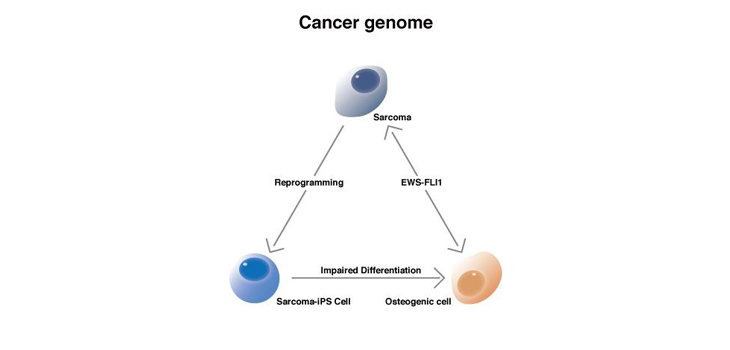
“However, when random mutations were added with the EWS-FLI1 gene, the mice grew tumors consistent of osteosarcomas, a type of bone cancer, when the EWS-FLI1 gene was activated. The researchers then attempted to reprogram the tumor cells into iPS cells (sarcoma-iPS cells), succeeding in two cases.”
“The acquisition of sarcoma-iPS cells allowed the scientists to observe how the additional mutations affect cell differentiation. In sarcoma-iPS cells in which the EWS-FLI1 gene was not activated, no tumors formed but aberrant differentiation was found.”
“Osteogenic cells [which go on to produce bone cells] did not develop properly, ” said Dr. Yamada.
When the EWS-FLI1 gene was activated, the cells proceeded to form tumors. Yamada surmises that the unknown mutations affect the differentiation of osteogenic cells and that this mechanism is what makes the EWS-FLI1 gene oncogenic. He therefore proposes that the sarcoma-iPS cells could be valuable for drug discovery, as chemicals that correct the differentiation could prevent bone cancers from forming even in cases where the EWS-FLI1 gene is expressed.
Professor Yamada told OTW, “We wanted to design a mouse model for Ewing’s sarcoma. We experimented with some basic strategies and got a mouse model that did not perfectly recapitulate what we wanted, but proves to be a good model for small cell osteosarcoma. While our aim was to create a model for Ewing’s sarcoma, even though we used the EWS1-FLI1 gene we ended up getting a model that might be more appropriate for small cell osteosarcomas.”
React:
Discussion
This is a fascinating development. In my practice we've seen similar outcomes with the revised protocol. The key differentiator seems to be patient selection criteria. Has anyone else noticed the correlation with BMI thresholds?
Great point. I'd push back slightly on the conclusion, the sample size in the cited study is too small to draw population-level inferences. That said, the directional signal is compelling and worth a larger RCT.
We implemented a similar approach last year. Early results are promising but we're still gathering 12-month follow-up data. Happy to share our protocol if anyone is interested.
Join the conversation
Orthopedic professionals are discussing this. Sign in and upgrade to read every comment and add your voice.