
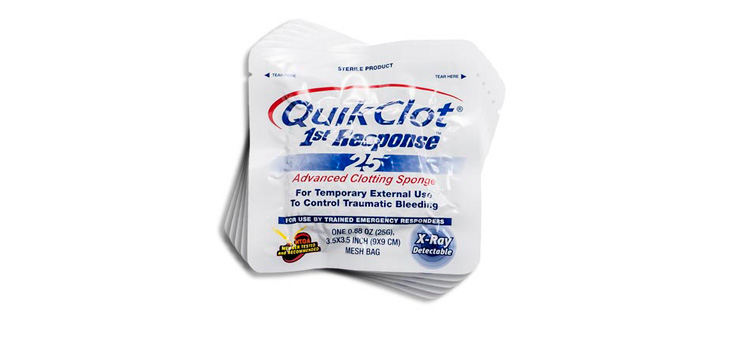
Z-Medica, LLC, a developer and marketer of hemostatic devices, has received an expanded CE Mark for its QuikClot products in the European Union (EU). The expanded indication includes the use of the company’s kaolin-based hemostatic products for traumatic bleeding used in conjunction with anti-coagulant therapy. The indications for use in the EU are now the same as they are for the U.S.
Kaolin-Based Hemostat Gets Expanded CE Mark
1 min read Premium comments
Secondary
Z-Medica products are designed for external use to control traumatic bleeding. They are indicated as a topical dressing for the managements of bleeding wounds, as a temporary treatment of surgical wounds and traumatic injuries and as an adjunct to manual compression and control of surface bleeding from vascular access sites.
“QuikClot has had a presence in the European markets for quite some time, ” said Z-Medica’s President and CEO Stephen J. Fanning. “The expanded indication means that millions more throughout Europe now have the full benefit of our life-saving technology.”
Z-Medica, LLC was founded in 2002. The Naval Medical Research Center and the U.S. Army Institute for Surgical Research’s Committee on Tactical Combat Casualty Care chose QuikClot Combat Gauze as the hemostatic dressing of choice on the battlefield for compressible hemorrhage not amenable to tourniquet use or as an adjunct to tourniquet removal if evacuation time is anticipated to be longer than two hours.
Author
React:
Discussion
This is a fascinating development. In my practice we've seen similar outcomes with the revised protocol. The key differentiator seems to be patient selection criteria. Has anyone else noticed the correlation with BMI thresholds?
Great point. I'd push back slightly on the conclusion, the sample size in the cited study is too small to draw population-level inferences. That said, the directional signal is compelling and worth a larger RCT.
We implemented a similar approach last year. Early results are promising but we're still gathering 12-month follow-up data. Happy to share our protocol if anyone is interested.
Join the conversation
Orthopedic professionals are discussing this. Sign in and upgrade to read every comment and add your voice.