
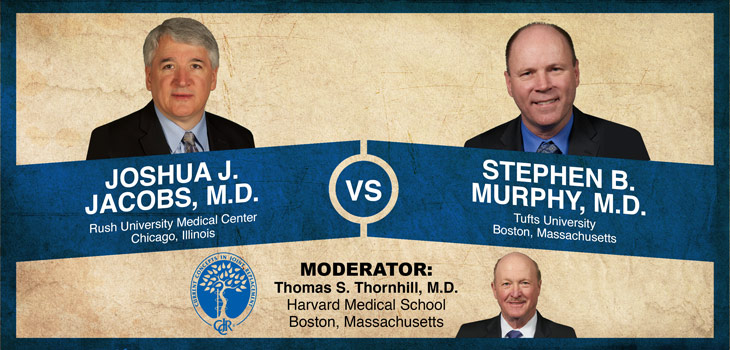
This week’s Orthopaedic Crossfire® debate was part of the 32nd Annual Current Concepts in Joint Replacement® (CCJR) – Winter meeting, which took place in Orlando this past December. This week’s topic is “Distal Neck Modularity in Primary THA: The Bridge Too Far.” For the proposition is Joshua J. Jacobs, M.D., Rush University Medical Center, Chicago, Illinois. Opposing is Stephen B. Murphy, M.D., Tufts University, Boston, Massachusetts. Moderating is Thomas S. Thornhill, M.D., Harvard Medical School, Boston, Massachusetts.
Jacobs v. Murphy: Distal Neck Modularity in Primary THA: The Bridge Too Far
8 min read Premium comments
Great Debates
Dr. Jacobs: So dual-taper stems were supposed to be a good idea because they allow surgeons to independently control femoral fixation and hip center restoration by having the modular necks allow adjustments to leg length and offset and version intra-operatively.
But, what problem are we really solving? Are we solving a dislocation problem? Are we providing better function, better survivorship? Because we can use smaller incisions to get these modular necks in are we improving the efficiency, speed of recovery?
I don’t know and I’m waiting for from my esteemed colleague to present compelling evidence that we have a problem we can fix with this technology. Furthermore, according to a very sage individual I happen to work with, there’s no such thing as a free lunch.
The price you pay with this technology is adverse local tissue reaction (ALTR) secondary to tribocorrosion and this is primarily or almost exclusively seen in cobalt alloy necks. Or fracture, which is more prominently seen with titanium alloy necks.
There have been a number of case reports…we looked at 12 hips in 11 patients revised for ALTR. Relatively recently. Primarily women. Either metal-on-poly or ceramic-on-poly bearing. These results aren’t necessarily generalizable but nonetheless the series is available and really got our attention.
The patients presented quite early, with pain primarily, sometimes with instability. Very low Harris hip score. MRIs showing adverse local tissue reactions with large fluid collections and soft tissue effects similar to what you’d see with a metal-on-metal bearing. We saw an elevation of cobalt out of proportion to chromium. Interestingly there was no elevation in titanium, which of course, is the female side of this connection.
What about fracture? We published a case report a number of years ago. What was remarkable with a titanium alloy neck…is the massive corrosion of the titanium alloy. This is not supposed to happen in vivo, and yet it happened in these particular circumstances with head/neck modularity. Grupp, et al. have a series where they looked at 5, 000 titanium alloy modular necks and the cumulative fracture rate was 2.4%; risk factors being male gender, varus necks and patient weight risk factors. Therefore, they abandoned titanium alloy because of this fracture risk in favor of cobalt alloy necks. Then that opens them up to the problem of adverse local tissue reaction.
The Australian registry has excellent data to guide us on these issues. First of all the cumulative percent revision for these exchangeable necks or modular necks is much higher than fixed necks (11% vs. 6% at 13 years). This is for all comers. But if you look at the six implant systems that had at least seven year data the revision rate is greater with the exchangeable necks than the fixed necks for all of them. And why are they being revised? Primarily for loosening lysis but also for dislocation. This is very interesting because that might have been one of those things that you’d expect these modular necks to address. So I’m not sure what problem we’re solving, in fact it looks like we’ve created some.
In conclusion, given these known complications, the unanswered questions, potential morbidity revision surgery and the unproven benefits—in my mind there is little justification for the use of modular neck femoral components in total hip arthroplasty.
Dr. Murphy: I think there are a number of things we can agree on. Early on I learned a lot about joint preserving surgery and think that proper reconstruction on a femoral side, pathomechanically, requires control at the neck-shaft junction and this is clear, not only for acetabular dysplasia and femoral dysplasia, but also for hip replacement. It is as true today as it was 65 years ago.
What are the theoretical advantages of modular neck-stem tapers? The answer is greater control of anteversion and offset, more options at the time of any revision for instability, wear, impingement, and if you do a revision, you can put a neck in, potentially, and then use a proper ceramic head without adding a titanium sleeve to it.
Certainly there are well-proven designs (S-ROM, DePuy Synthes, Warsaw, IN, USA) that have a modular connection proximally, but don’t really give you independent control between the stem and the neck, so it really doesn’t address most of the issues that we’re talking about.
If you go to the lab and you do ultimate strength testing, cobalt chrome necks in these modular tapers are incredibly strong and you would think that they would be impossible to break. And if you do fatigue testing, again, the results are very impressive. The fatigue strength looks superb. You can even reproduce the fractures in vitro that occurred in vivo using a cobalt chrome or a titanium neck—and they look virtually identical.
So this is very impressive lab data, very strong, and when the metal breaks you can predictably see where it’s going to happen. Well, what about reality? In reality, if you use cobalt chrome necks, they work in the body; they expose some of the cobalt chromium to the patient’s hip joint. That may incite a metal hypersensitive reaction, and 1-2% of patients do get that. When they get that, with the corrosion, they also get elevated cobalt over chromium levels, capsular thickening on MRI, and in some designs, adverse local tissue reactions.
For me, if you’re talking about specifically a tiny little spot up at the top of the stem, I do agree with Josh that there are no current designs that have proven to be sufficiently reliable in more than 99% of patients without problems, and in vitro testing has failed to predict what has happened in reality. Possibly because of in vivo assembly factors, and, the effect of mechanically assisted crevice corrosion.
So what has proven to be reliable in terms of the modular taper at the top end? Well, certainly a stem that has been around for more than 20 years (MP, Waldemar Link, Hamburg, Germany); it has a superb track record; very robust connection between the titanium proximal body and the stem. I’ve used this personally since 1997 without a device failure or reaction. This stem has failures that are so uncommon that they’re still reportable after 20 years, but they really have a very limited role in primary hip replacement. A study that Dr. A. Seth Greenwald and Paul Postak did years ago showed very high fatigue strength of this particular construct in a worst case scenario.
In summary, I think there are space limitations at the top. There are metallurgical limitations in terms of how strong and fatigue resistant these alloys are. And to me, it doesn’t appear that any modular neck connection that doesn’t extend into the metaphysis is sufficiently reliable to warrant routine clinical use in primary hip. And the robust conjunctions require a lot of space and as such are not routinely indicated for primary total hip replacement.
I think that many of us can agree that having control at the neck-stem junction would be ideal because we can control many variables that otherwise we would get in trouble with — the reconstruction, instability, or failure to correct the pathomechanics. On the other hand, having a really small amount of space up there with the metals that we have right now, I just don’t think that anybody has done this successfully, so in many respects I agree with Josh, but I do think this is the area where we need to get it right and we have not gotten it right yet.
Moderator Thornhill: Let me get this straight, Steve. I think you said in 99% of the cases, remember we’re talking about distal neck modularity, so does that mean that in 1% of your primaries you would still use distal neck modularity or do you not use it at all?
Dr. Murphy: No, no, I think our benchmark is that if you look at our field and the pathomechanics, if you don’t correct the pathomechanics properly and you’re stuck with a toolbox that’s pretty limited, you’re going to have clinical problems. If you use things that do solve the problem for you, you’re going to have clinical problems on the implant side. I just don’t think we can tolerate any device that has…
Moderator Thornhill: Wait, wait, whoa, hang on Steve. This is not a political debate. What I was asking you is, is there anybody at the present time that you would use distal neck modularity in for a primary total hip? Yes or no.
Dr. Murphy: In a simple primary situation I don’t think so.
Moderator Thornhill: Josh, let’s say that you’re following a patient who had distal neck modularity for his/her primary hip and the patient’s doing well. Comes in to see you every couple of years and says, ‘I’m really doing great.’ Nothing looks bad on X-ray. What do you do? You measure blood levels and then give me a blood level at which you would revise them.
Dr. Jacobs: That’s a great question. First of all, this is my kind of debate when my opponent makes my points for me, so I really like this. That’s another one of these unanswered questions, how do you follow these patients and when do you pull the trigger for revision? It’s easy if they’re asymptomatic. I’m not even sure you need to do metal ion levels. The issue is when they become symptomatic and they can become symptomatic for a number of reasons, but if it’s due to an adverse local tissue reaction, that’s when metal ion levels and cross-sectional imaging are really indicated.
Moderator Thornhill: So no metal ions if they’re doing fine. How about MRI, ultrasound?
Dr. Jacobs: Again, if they’re doing fine I don’t see the reason for it. If they’re symptomatic, I think there’s a reason to do it.
Moderator Thornhill: Josh, I want to go to the top side of that modularity because you’ve done as much as anybody in the world to make that…you said that this sort of corrosion only occurs if you have a cobalt chrome bearing. Should we all be using ceramic heads in our primary hips and what about the use of titanium sleeves on old tapers?
Dr. Jacobs: A good question. The point I made is adverse local tissue reactions have only been seen, with maybe some rare exceptions, when at least one of the components is a cobalt chrome component—either the neck or the head. You can see severe corrosion with titanium-titanium junctions. The difference is that the body seems to tolerate titanium alloy debris much better than cobalt alloy debris. So you don’t see those sorts of adverse local tissue reactions. The question about whether we should be abandoning cobalt heads because of this problem with head/neck corrosion or trunionosis, is an interesting one. I worry a little bit because there may be some unintended consequences with wide sale, wholesale adoption of ceramic heads. And don’t forget we have been using cobalt heads for a very long period of time. The key is to design a head/neck taper to minimize micromotion. And that can be done. It has been done. And that’s the issue.
Moderator Thornhill: Thank of you for a very nice debate.
Please visit www.CCJR.com to register for the 2016 CCJR Spring Meeting, May 22 – 25 in Las Vegas.
React:
Discussion
This is a fascinating development. In my practice we've seen similar outcomes with the revised protocol. The key differentiator seems to be patient selection criteria. Has anyone else noticed the correlation with BMI thresholds?
Great point. I'd push back slightly on the conclusion, the sample size in the cited study is too small to draw population-level inferences. That said, the directional signal is compelling and worth a larger RCT.
We implemented a similar approach last year. Early results are promising but we're still gathering 12-month follow-up data. Happy to share our protocol if anyone is interested.
Join the conversation
Orthopedic professionals are discussing this. Sign in and upgrade to read every comment and add your voice.