
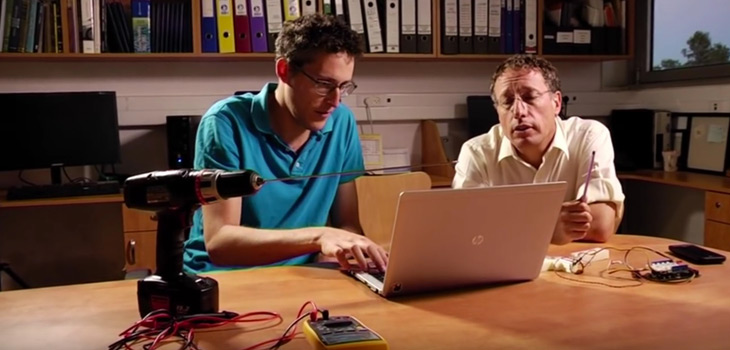
Physicians, along with engineering and business students from The Hebrew University’s BioDesign: Medical Innovation program, are pushing the envelope with the development of a new surgical guidewire. Their system, one that provides real-time indications of deflection or bending of the guide-wire, gives the surgeon the ability to adjust the procedure before damage occurs. Welcome, BendGuide!
Israeli Pioneers Development Guidewire With Real-Time Feedback
2 min read Premium comments
Secondary
“This is a significant challenge”, said Professor Meir Liebergall, head of the Department of Orthopedic Surgery at Hadassah Medical Center, in the February 23, 2016 news release, “as complications in guide-wire positioning could lead to revision surgeries and increase hospitalization time and cost.”
“This is an elegant technological solution to a complex problem, ” said Professor Yaakov Nahmias, director of The Hebrew University’s Alexander Grass Center for Bioengineering and the BioDesign program. “The group model and proof-of-concept experiments showed they could detect even miniscule changes in guide-wire trajectory.”
According to the news release, “BendGuide uses a fiber bundle with a reflecting laser beam that enables detection of small deflections in wire trajectory. At a fully-aligned state, the beam power hits the center of the detector array. When deflected, mirror misalignment causes the power to spread differentially across the fiber bundle.”
Professor Nahmias told OTW, “Perhaps the most surprising aspect of our project is the accuracy needed for these types of orthopedic procedures. The length of the guidewire amplifies even small deflections from the planned trajectory leading to incorrect fixation of the bones.”
“Our initial thoughts of using conductive flex sensors or simple optical reflection had to be discarded as they were simply not sensitive enough. We went through several models to develop the fiber bundle solution, which is quite elegant.”
“A steady hand is not enough. Guidewires can bend or deflect deep in the bone where you won’t feel the change in trajectory. This might be the tool you have been waiting for.”
Asked how future research should proceed, Professor Nahmias commented to OTW, “We are looking to raise the funding to build a full prototype in the coming months. There are some technical challenges that need to be addressed in the design of the materials and the instrument as a whole.”
React:
Discussion
This is a fascinating development. In my practice we've seen similar outcomes with the revised protocol. The key differentiator seems to be patient selection criteria. Has anyone else noticed the correlation with BMI thresholds?
Great point. I'd push back slightly on the conclusion, the sample size in the cited study is too small to draw population-level inferences. That said, the directional signal is compelling and worth a larger RCT.
We implemented a similar approach last year. Early results are promising but we're still gathering 12-month follow-up data. Happy to share our protocol if anyone is interested.
Join the conversation
Orthopedic professionals are discussing this. Sign in and upgrade to read every comment and add your voice.