
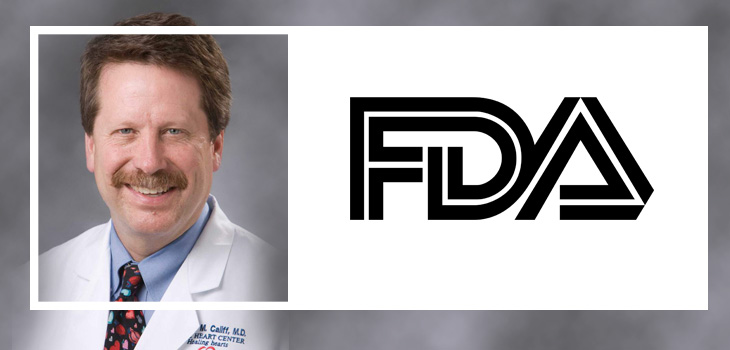
The U.S. Senate finally confirmed cardiologist Robert Califf, M.D. as the permanent FDA Commissioner. His tenure may be short-lived as a new president takes over in 2017 and will likely nominate his or her own agency head. Senators voted 89-4 to give him the job.
FDA Commissioner Confirmed, Budget Battle Looms
2 min read Premium comments
Secondary
The four senators who voted against the nomination, Republican Kelly Ayotte of New Hampshire, and Democrats Richard Blumenthal of Connecticut, Ed Markey of Massachusetts and Joe Manchin of West Virginia, were all upset with the FDA over the agency’s perceived lack of action in combating an opioid epidemic.
The senators also voiced concerns about Califf’s ties to the pharmaceutical industry.
Califf has been the Acting Commissioner since last October when the previous commissioner, Margaret Hamburg, M.D. resigned after a relatively successful tenure. Califf has deeper roots to industry than any FDA commissioner in recent memory. He founded and ran the Duke Clinical Research Institute, a $200 million center that manages clinical trials for industry in more than 65 countries involving more than 1.2 million patients.
The Budget
One of Califf’s first jobs will be to get Congress to pass President Obama’s 2017 FDA budget request.
The President is requesting an 8% increase in funding to address drug compounders, device submissions and supply chain security, among other initiatives. The overall request includes a net increase of $14.6 million in budget authority and $268.7 million in user fees for tasks such as improving medical product safety and quality, and implementing the FDA Food Safety Modernization Act (FMSA).
The request also includes $75 million in new mandatory funding to support the National Cancer Moonshot initiative.
The request for $2.8 billion in 2017 for FDA’s Medical Product Safety and Availability programs is an increase of $116.2 million above the 2016 enacted level. The request includes $1.3 billion for budget authority—an increase of 0.2% or $3.2 million compared to the 2016 enacted level—and an increase of $38 million in user fees.
With the new money, the FDA says it will establish the National Medical Device Evaluation System (NES), which is a strategic priority for this year, to identify patients who benefit from specific types of devices.
The requested increase in funding would also be used to support speeding up ongoing reviews of medical device applications, as well as addressing public health safety concerns associated with antimicrobial drug use in animals to better protect antibiotic effectiveness for both human and animal populations.
Author
React:
Discussion
This is a fascinating development. In my practice we've seen similar outcomes with the revised protocol. The key differentiator seems to be patient selection criteria. Has anyone else noticed the correlation with BMI thresholds?
Great point. I'd push back slightly on the conclusion, the sample size in the cited study is too small to draw population-level inferences. That said, the directional signal is compelling and worth a larger RCT.
We implemented a similar approach last year. Early results are promising but we're still gathering 12-month follow-up data. Happy to share our protocol if anyone is interested.
Join the conversation
Orthopedic professionals are discussing this. Sign in and upgrade to read every comment and add your voice.