
Things are looking good for Vital 5, Inc., a catheter company that aims to make a dent in postoperative pain for those undergoing orthopedic and spinal procedures. The company is announcing a successful series of orthopedic and spinal procedures in Logan, Utah and Chicago, Illinois.
Catheter for Spine, Other Procedures Showing Promise
1 min read Premium comments
Secondary
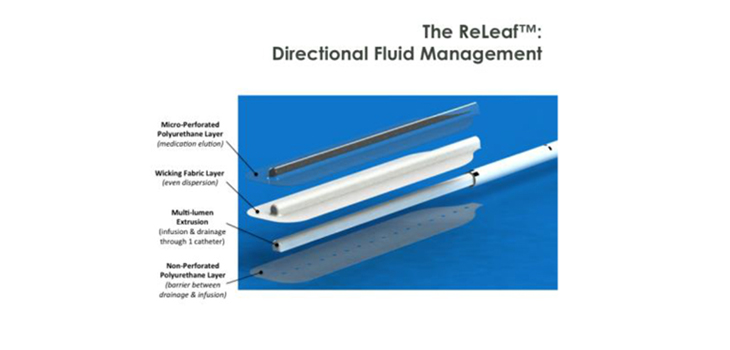
As indicated in the February 24, 2016 news release, “The FDA 510(k) cleared Vital 5 ReLeaf Catheter, designed by orthopedic spinal surgeons Kern Singh, M.D. and Frank M. Phillips, M.D., delivers a continuous and controlled amount of local anesthetic to the surgical site via its proprietary ‘leaf catheter’ design. The effectiveness of the catheter is further enhanced by directional dispersion of local anesthesia and directional wound drainage from the surgical site, providing broad applicability in general surgery, cardio-thoracic, plastic, orthopedic and neurosurgical procedures. In addition to spinal procedures, the device has been used in over 25 total knee arthroplasty procedures since October 2014.”
“The Vital 5 ReLeaf Catheter is uniquely designed for spinal applications by the safe and directional delivery of a regulated flow of local anesthetic to a patient’s surgical site in close proximity to neural elements for the treatment of postoperative pain. In addition, the catheter functions to simultaneously drain excess fluids from the operative site.”
“The unique design characteristics of the device make it uniquely suited to spinal applications”, stated Dr. Singh.
Dr. Phillips commented, “With the ability to effectively manage post-operative pain, I see ReLeaf allowing more surgeries to be accomplished in out-patient settings.”
Asked for details about the dispersion of local anesthesia and directional wound drainage, Dr. Singh told OTW, “The catheter is designed to specifically limit and control for dispersion. This allows the catheter to be uniquely placed next to neural structures.”
Regarding an interesting milestone, Dr. Singh noted, “It was creating a catheter/drainage system that would allow for controlled dispersion while also being able to drain the surrounding fluids. In laymen’s terms, we wanted to create a design that allows the drain to release medication in a specific area without sucking it all up in the drain.”
Author
React:
Discussion
This is a fascinating development. In my practice we've seen similar outcomes with the revised protocol. The key differentiator seems to be patient selection criteria. Has anyone else noticed the correlation with BMI thresholds?
Great point. I'd push back slightly on the conclusion, the sample size in the cited study is too small to draw population-level inferences. That said, the directional signal is compelling and worth a larger RCT.
We implemented a similar approach last year. Early results are promising but we're still gathering 12-month follow-up data. Happy to share our protocol if anyone is interested.
Join the conversation
Orthopedic professionals are discussing this. Sign in and upgrade to read every comment and add your voice.