
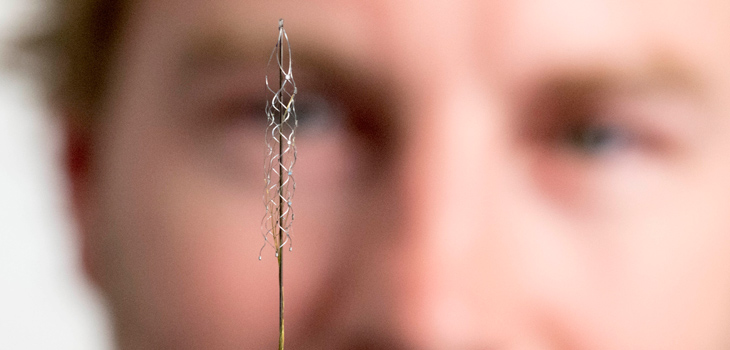
You might call it the, “I think therefore I walk” machine. In a world’s first, researchers from Australia have created a minimally invasive brain/machine interface. The paperclip-sized electrode will be tested in a human trial at the Royal Melbourne Hospital in 2017.
Bionic Spine Could Help Paralyzed Patients Walk
2 min read Premium comments
Secondary
As indicated in the February 8, 2016 news release, “Co-principal investigator and biomedical engineer at the University of Melbourne, Nicholas Opie, Ph.D., said the concept was similar to an implantable cardiac pacemaker—electrical interaction with tissue using sensors inserted into a vein, but inside the brain.”
“Utilising stent technology, our electrode array self-expands to stick to the inside wall of a vein, enabling us to record local brain activity. By extracting the recorded neural signals, we can use these as commands to control wheelchairs, exoskeletons, prosthetic limbs or computers, ” Dr. Opie said.
Dr. Opie told OTW, “I can’t comment on what orthopaedic surgeons would find interesting, but with recent advances in prosthetic limbs attached using osseointegration, I would not be surprised if there could be some symbiosis in the future between these two technologies.”
“The primary milestones that I found interesting include the ability to implant the device safely, the ability to record this high-fidelity neural information, and the ability to do this safely over a chronic period.”
“Essentially, we were trying to develop a minimally invasive way to acquire neural information to enable people with paralysis to control wheelchairs, exoskeletons and prosthetic limbs using their thoughts alone.”
“With the recent developments in body armor and faster medical response times, more soldiers are returning from combat, however a larger number are returning with serious loss-of-limb injuries. To return mobility and independence to these people, the U.S. Defense force, DAPRA (Defense Advanced Research Projects Agency) have dedicated significant resources to develop robotic limbs and technology. While these remarkable prosthetic devices are capable of possessing all the movements of a normal hand or leg (for example), the ability to connect these devices to the user over a long period of time is the current limitation.”
“Existing electrodes (sensors to pick up the thought-controlled movements) need to pick signals from the brain directly. Historically, access to the brain has been performed by removing the skull and implanting electrodes directly into the brain or laying them on the surface of the brain. This open-brain surgery is a risky procedure with a relatively high complication rate. Further, these electrodes that are penetrated into the brain are covered in scar tissue and slowly rejected by the body. This has been reported to render many electrodes useless over a period of time.”
“To avoid this, we have developed a novel technology that can be delivered to the brain through a blood vessel. This mitigates risks with open brain surgery, and, as our electrode arrays are not in direct contact with the brain (are within a protective blood vessel) our technology does not get rejected in the same way as penetrating electrodes.”
“Our recent publication in Nature Biotechnology (Oxley, Opie, et al., 2016), we demonstrated the ability of our device to be implanted safely in preclinical trials and be able to record neural information for longer than 6 months. Further, we demonstrated the blood vessel remained patent, and that there was no indication of vascular occlusion.”
Author
React:
Discussion
This is a fascinating development. In my practice we've seen similar outcomes with the revised protocol. The key differentiator seems to be patient selection criteria. Has anyone else noticed the correlation with BMI thresholds?
Great point. I'd push back slightly on the conclusion, the sample size in the cited study is too small to draw population-level inferences. That said, the directional signal is compelling and worth a larger RCT.
We implemented a similar approach last year. Early results are promising but we're still gathering 12-month follow-up data. Happy to share our protocol if anyone is interested.
Join the conversation
Orthopedic professionals are discussing this. Sign in and upgrade to read every comment and add your voice.