
A total hip replacement is usually a successful procedure, restoring mobility and reducing pain. More than 300, 000 such surgeries are performed every year in the U.S. according to the Agency for Healthcare Research and Quality. Less successful have been some of the surgeries on younger patients as the artificial hip has a limited lifetime and often requires patients to restrict their physical activity.
Alternative Technique Extends Life of Resurfaced Joint
2 min read Premium comments
Secondary
Brett Crist, M.D., an associate professor of orthopedic surgery at the University of Missouri School of Medicine, said, “Resurfacing a joint with donated bone and cartilage tissue is often a better option for young patients with active lifestyles. Traditional repairs using metal and plastic components begin to wear immediately, so patients must limit activity to reduce damage to their new joints. Although a biological approach may be a better solution, there is no standard method for implantation. Our team compared a common technique with a method developed at the Missouri Orthopaedic Institute to determine if we could further improve joint function.”
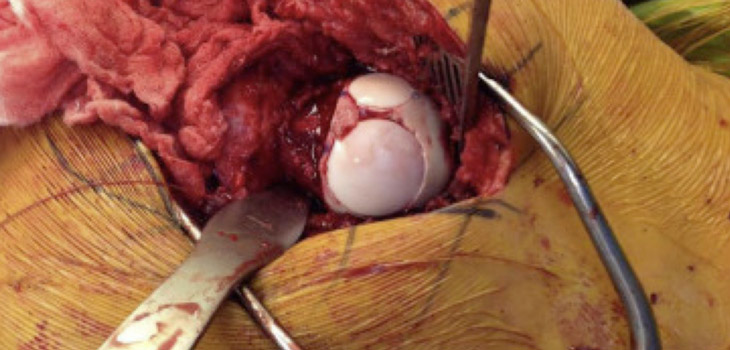
One method of implanting donor tissue into the femur part of the hip joint is to use multiple small, cylinder-shaped plugs of bone and cartilage to fill in a damaged area. Crist’s team tried a different approach. They used larger, size-matched grafts to cover the area in need of repair. The larger grafts also had beveled edges to provide a better fit.
The researchers experimented with both methods on dogs. They found that the dogs implanted with traditional small grafts showed significant loss in range of motion and joint integrity after only eight weeks. However, the dogs implanted with larger, bevel-shaped grafts maintained joint viability and structural integrity throughout the six-month study period.
“By using one large graft, we reduced the number of seams for a smoother functioning joint, ” Crist said. “Beveling the edges also created a better fitting repair that was less prone to cell death during implantation.”
Crist is quick to say that more studies are needed. He does maintain that his study provides evidence that larger, size-matched grafts may improve outcomes when resurfacing cartilage defects of the femoral head in the hip joint.
The study is titled “Optimizing Femoral-head Osteochondral Allograft Transplantation in a Preclinical Model, ” and has been published in the Journal of Orthopaedic Translation.
Author
React:
Discussion
This is a fascinating development. In my practice we've seen similar outcomes with the revised protocol. The key differentiator seems to be patient selection criteria. Has anyone else noticed the correlation with BMI thresholds?
Great point. I'd push back slightly on the conclusion, the sample size in the cited study is too small to draw population-level inferences. That said, the directional signal is compelling and worth a larger RCT.
We implemented a similar approach last year. Early results are promising but we're still gathering 12-month follow-up data. Happy to share our protocol if anyone is interested.
Join the conversation
Orthopedic professionals are discussing this. Sign in and upgrade to read every comment and add your voice.