
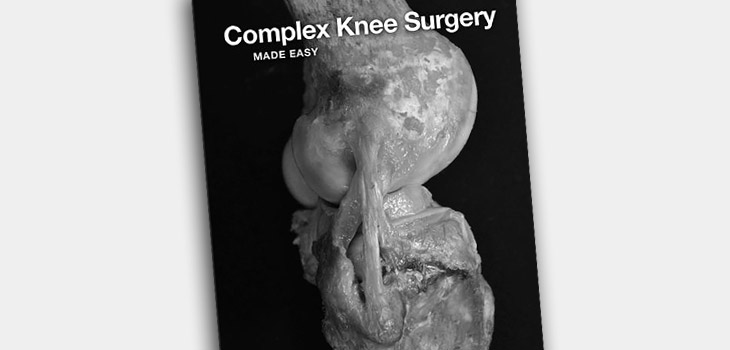
Several knee gurus have come up with an important new resource for virtually anyone interested in knee surgery. Drs. Robert LaPrade, Jorge Chahla and Chase Dean of the Steadman Philippon Research Institute have published “Complex Knee Surgery Made Easy, ” the first free educational interactive digital book of its kind in sports medicine.
Steadman Philippon Surgeons Develop Free E-Book for Knee Surgery
2 min read Premium comments
Secondary
According to the February 23, 2016 news release, readers will learn: knee anatomy structures, diagnostic tips for knee conditions, demonstrations of surgical techniques for specific knee injuries, postoperative instructions and rehabilitation protocols.
“This book is visually designed to review the most common sports medicine pathologies in the knee. The chapters are loaded with pictures and videos that maximize comprehension. The book is formatted in bullet point style to facilitate the reader’s experience. It can also serve as a quick review for a surgical procedure where the main tips are highlighted to achieve successful outcomes.”
Dr. LaPrade said, “This work was comprised to benefit surgeons and their patients by providing a comprehensive overview of complex knee injuries. I frequently receive consultations from colleagues, almost daily, and through this work we have attempted to provide answers to many of the common questions that I am asked. It is a pleasure to be able to provide this work to the medical community.”
As indicated in the news release, “The first step to a successful surgical outcome is an accurate diagnosis. Since a physical exam is the most important diagnostic tool, the book includes videos demonstrating proper diagnostic techniques. A thorough exam will help determine the exact location of a lesion; therefore, it is vital to establish a systematic exam in order to avoid missing any important clinical features. Magnetic resonance imaging (MRI) is essential in differentiating between injuries and enables a physician to locate the precise site and severity of lesions. This book provides a series of educational videos taught by Dr. LaPrade on how to properly identify different knee injuries through MRI.”
“Dr. Chahla and I are thrilled to be able to share the knowledge that Dr. LaPrade has taught us. We are excited that people all over the world will be able to learn from Dr. LaPrade. We would like to thank Dr. LaPrade for his mentorship, as well as the Steadman Philippon Research Institute, ” said Dr. Chase Dean.
Dr. LaPrade told OTW, “The most challenging part of preparing this book was obtaining the ideal photos and video clips to best demonstrate the anatomic details and surgical steps.”
“We want orthopaedic surgeons to recognize that this is a resource which should help to answer many of the questions and provide technical pearls for many complex knee surgeries. Ideally it can be used by medical students, residents, fellows and faculty alike because many of the anatomic details and surgical steps provide information that can be used by those with different levels of training.”
“Complex Knee Surgery Made Easy” is available for free download on iTunes.
Author
React:
Discussion
This is a fascinating development. In my practice we've seen similar outcomes with the revised protocol. The key differentiator seems to be patient selection criteria. Has anyone else noticed the correlation with BMI thresholds?
Great point. I'd push back slightly on the conclusion, the sample size in the cited study is too small to draw population-level inferences. That said, the directional signal is compelling and worth a larger RCT.
We implemented a similar approach last year. Early results are promising but we're still gathering 12-month follow-up data. Happy to share our protocol if anyone is interested.
Join the conversation
Orthopedic professionals are discussing this. Sign in and upgrade to read every comment and add your voice.