
New research from the National Institutes of Health (NIH) has found that bumping up the amount of tristetraprolin (TTP), a naturally produced protein, protects mice from inflammation…or significantly reduces inflammation.
Protein Found to Protect From Inflammation
2 min read Premium comments
Secondary
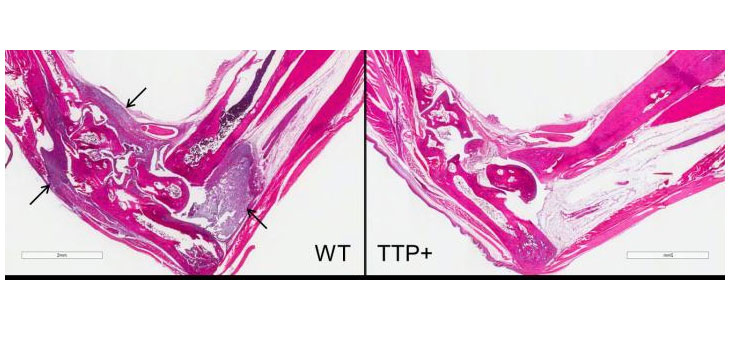
As indicated in the February 4, 2016 news release, “Perry Blackshear, M.D., D.Phil., a researcher at the National Institute of Environmental Health Sciences (NIEHS), part of NIH, led the team that genetically altered the TTP gene in mice, so that the animals produced higher than normal amounts of the TTP protein. The mice were then tested using experimental models of rheumatoid arthritis, psoriasis, and multiple sclerosis. Experimental models are used to study processes thought to be involved in human diseases, and to evaluate and select therapies that affect these processes.”
“Mice with more TTP in their bodies were resistant to the inflammation that accompanied these experimental models of disease, ” Blackshear said. “We also found evidence of how TTP is providing this protection.”
Dr. Blackshear told OTW, “Our initial discovery was that the protein known as TTP was a potent, naturally occurring anti-inflammatory protein, based on experiments in mice in which the gene had been deleted. We theorized that, if the absence of the protein resulted in inflammation from over-production of pro-inflammatory cytokines, which are pro-inflammatory proteins involved in cellular communication, having higher than normal levels might be beneficial in a variety of inflammatory diseases. We were very gratified to find that higher levels of expression, at least in the mouse, prevented the development of several models of inflammatory disease.”
“In future work, in which we will attempt to identify potential treatments using this new pathway, we hope to avoid some of the problems associated with current anti-cytokine therapies, including the need for injections, the expensive recombinant DNA techniques used in the production, and some serious side effects.”
“Among the diseases targeted in this research are rheumatoid arthritis, psoriatic arthritis, and ankylosing spondylitis, a condition involving inflammation of the spine. All of these diseases are of interest to orthopedic surgeons. We have also become aware of recent data supporting a role for pro-inflammatory cytokines in the development of osteoarthritis. We think our proposed TTP-based therapies might be of benefit in these conditions, and we are excited about trying our experimental procedures in animal models of osteoarthritis.”
Author
React:
Discussion
This is a fascinating development. In my practice we've seen similar outcomes with the revised protocol. The key differentiator seems to be patient selection criteria. Has anyone else noticed the correlation with BMI thresholds?
Great point. I'd push back slightly on the conclusion, the sample size in the cited study is too small to draw population-level inferences. That said, the directional signal is compelling and worth a larger RCT.
We implemented a similar approach last year. Early results are promising but we're still gathering 12-month follow-up data. Happy to share our protocol if anyone is interested.
Join the conversation
Orthopedic professionals are discussing this. Sign in and upgrade to read every comment and add your voice.