
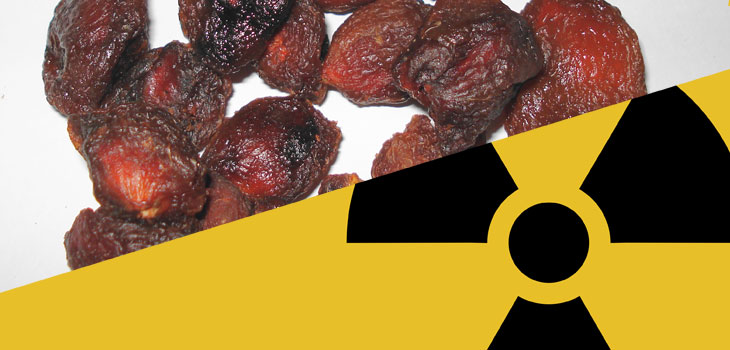
Should you pop a few dried plums the next time you go for an X-ray? Maybe so. A new study just published in Scientific Reports suggests that dried plums may help to prevent bone loss in those exposed to radiation. The animal study, done at the University of California, San Francisco and Veterans Affairs, University of California, Irvine, and Texas A&M University, could have implications for those undergoing radiation therapy, those who have to work around radiation, and astronauts.
Plums Counter Bone Loss in Those Exposed to Radiation
2 min read Premium comments
Secondary
As indicated in the February 11, 2016 news release, “Researchers from the University of California, San Francisco and Veterans Affairs, University of California, Irvine, and Texas A&M University looked at the effect of various antioxidant or anti-inflammatory interventions—including an antioxidant cocktail, dihydrolipoic acid (antioxidant), ibuprofen (anti-inflammatory), dried plum powder (antioxidant) and a control—on mice that received radiation. Researchers observed that the dried plum powder was the most effective in reducing undesired bone marrow cells’ responses to radiation compared to the other interventions. Additionally, the researchers observed that mice on the dried plum diet did not exhibit decrements (bone volume loss) after exposure to radiation in any of the structural parameters measured. The results of this study suggest that dried plums may serve as an effective intervention for bone loss due to unavoidable exposure to space radiation or radiation therapy.”
“Previous clinical trials also indicate that dried plums may help to preserve bone health. A clinical research study published in the British Journal of Nutrition suggests eating two servings (about 10 to 12 dried plums) daily, may improve bone mineral density (BMD) and slow the rate of bone turnover in post-menopausal women. New research shows eating half that amount daily, just slightly more than one serving, (about 5 to 6 dried plums), may also help prevent bone loss in post-menopausal women.”
Bernard Halloran, Ph.D., professor of medicine at the University of California, San Francisco and Veterans Affairs. said in the news release, “We would love to further investigate the effect of dried plums on bone health for those who have been exposed to radiation, since this provides a promising and practical way to counter the detrimental effects of radiation on bone strength. Additional research will also help us to determine more about the specific mechanism that allows dried plums to have a protective effect on our skeleton.”
Dr. Halloran told OTW, “At this time we need to identify the bioactive factors in dried plums; we will do that via chromatography and mass spectrometry. Once we have this data I expect that factors may be used to speed fracture healing, spine fusion and repair of critical defects. The bottleneck now is identifying the bioactive factors in dried plum.”
Author
React:
Discussion
This is a fascinating development. In my practice we've seen similar outcomes with the revised protocol. The key differentiator seems to be patient selection criteria. Has anyone else noticed the correlation with BMI thresholds?
Great point. I'd push back slightly on the conclusion, the sample size in the cited study is too small to draw population-level inferences. That said, the directional signal is compelling and worth a larger RCT.
We implemented a similar approach last year. Early results are promising but we're still gathering 12-month follow-up data. Happy to share our protocol if anyone is interested.
Join the conversation
Orthopedic professionals are discussing this. Sign in and upgrade to read every comment and add your voice.