
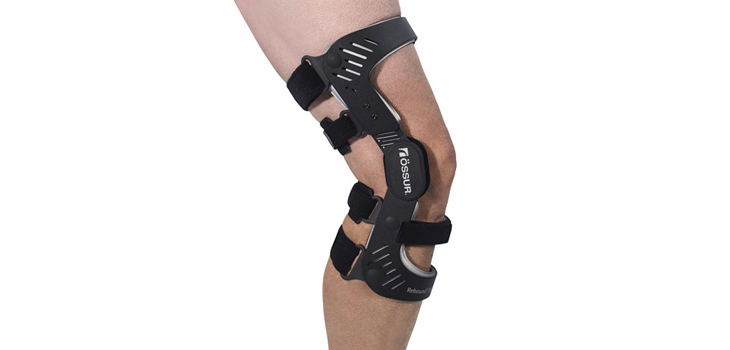
The prosthetic and orthopedic wizards at Össur have launched their Rebound DUAL, a brace for people with ligament issues, including ligament instabilities and osteoarthritis (OA). According to the January 31, 2016 news release, the new Rebound DUAL features a lightweight aluminum framed with Össur’s proprietary SmartDosing controls. The controls allow patients to make fine-tune adjustments to the brace’s dynamic tension, a particularly important feature for individuals with painful knee OA.
Össur Launches Rebound DUAL Brace
1 min read Premium comments
Secondary
“Rebound DUAL offers clinicians and their patients the ideal combination of versatility and stability in a single bracing solution, ” said Jason Thorne, Össur’s vice president of Global Marketing OA&I Solutions. “It is flexible in design as well as in application, because it is suitable for prophylactic use in patients with ligament instabilities, as well as for those recovering from ligament injuries.”
Asked to provide details about what considerations went into the development process, Thorne told OTW, “The Rebound DUAL was designed with versatility in mind to create a functional knee brace that could be customized to each individual’s unique anatomy. With upper frame length adjustability, field-serviceable d-rings, malleable frame and capabilities for both ligament and osteoarthritis, the brace is adjustable to suit each patient’s needs. Our goal is to aid in stability and support for the patient, along with increasing comfort and compliance with the brace.”
“With the practitioner in mind, the Rebound DUAL was developed to be versatile to save on inventory, while still giving the practitioner the functional benefits needed for their patients. The Rebound DUAL is geared towards patients who participate in low-to-high impact activities, as well as sliding sports. We want our patients to go all out, in confidence with the Rebound DUAL brace on.”
React:
Discussion
This is a fascinating development. In my practice we've seen similar outcomes with the revised protocol. The key differentiator seems to be patient selection criteria. Has anyone else noticed the correlation with BMI thresholds?
Great point. I'd push back slightly on the conclusion, the sample size in the cited study is too small to draw population-level inferences. That said, the directional signal is compelling and worth a larger RCT.
We implemented a similar approach last year. Early results are promising but we're still gathering 12-month follow-up data. Happy to share our protocol if anyone is interested.
Join the conversation
Orthopedic professionals are discussing this. Sign in and upgrade to read every comment and add your voice.