
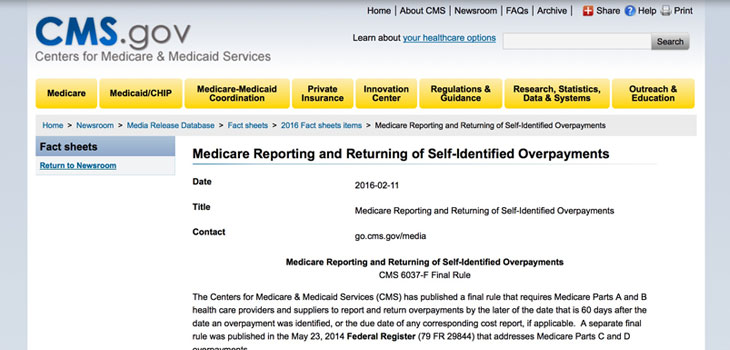
On Thursday, February 11, 2016, the Centers for Medicare and Medicaid Services (CMS) issued a final rule dealing with the return of overpayments made to providers.
New Rules for Returning Medicare Overpayments
2 min read Premium comments
Secondary
According to the agency, the major provisions of this final rule include clarifications around: “the meaning of overpayment identification; the required lookback period for overpayment identification; and the methods available for reporting and returning identified overpayments to CMS.”
The rule eases obligations for physicians and hospitals to return overpayments within 60 days to avoid False Claims Act liability, reduces how far back providers have to look for excess reimbursement and shortens the time of when the clock starts ticking on the repayments.
The original version of the overpayments rule required physicians to look back 10 years for claims to make sure Medicare had not overpaid them, but the final rule requires only a 6-year lookback. “Specifying the length and other parameters of the lookback period provides additional clarity for providers and suppliers who have identified an overpayment, ” stated an agency fact sheet about the rule.
The rule also clarifies what CMS means when it gives providers 60 days to report an overpayment and refund the money to Medicare. “Some providers say, ‘I got a hotline complaint that we’ve billed Medicare incorrectly, and I only have 60 days to find it and [return the money], ‘” said Tony Maida, an attorney with McDermott Will & Emery in a MedPage article. “That’s not what the rule says…. The clock doesn’t start to tick as soon as the call comes in, as long as the physician exercises reasonable diligence in looking into it.”
Instead, continued Maida, once such a call is received, “then there’s an obligation to decide if that call gives you what CMS calls ‘credible information’ of a potential overpayment and if it does…then the provider should exercise reasonable diligence to look into it, and determine whether in fact they have received an overpayment and how much that overpayment is. And once you go through that reasonable diligence process…At that point the 60 days to report and return [the overpayment] starts to run. Now if you get the hotline call and you don’t do anything, CMS says, ‘Well, you failed to exercise reasonable diligence and you may be violating this rule.'”
The rule also provides that if a health care provider or supplier has reported a self-identified overpayment to either the Self-Referral Disclosure Protocol managed by CMS or the Self-Disclosure Protocol managed by the Office of the Inspector General (OIG), “the provider or supplier is considered to be in compliance with the provisions of this rule as long as they are actively engaged in the respective protocol, ” stated the agency fact sheet.
To read the CMS fact sheet, click here.
Author
React:
Discussion
This is a fascinating development. In my practice we've seen similar outcomes with the revised protocol. The key differentiator seems to be patient selection criteria. Has anyone else noticed the correlation with BMI thresholds?
Great point. I'd push back slightly on the conclusion, the sample size in the cited study is too small to draw population-level inferences. That said, the directional signal is compelling and worth a larger RCT.
We implemented a similar approach last year. Early results are promising but we're still gathering 12-month follow-up data. Happy to share our protocol if anyone is interested.
Join the conversation
Orthopedic professionals are discussing this. Sign in and upgrade to read every comment and add your voice.