
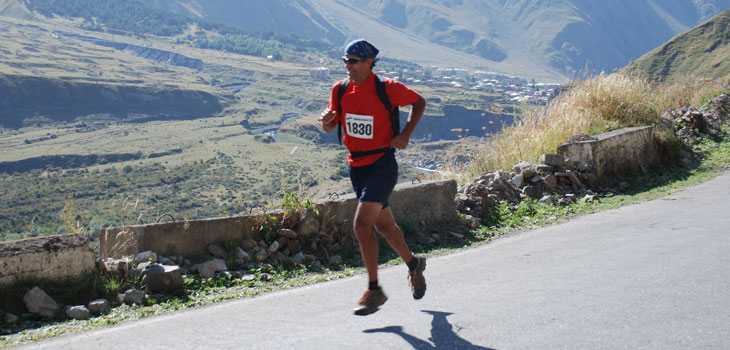
Which is better—running out of doors or on an indoor treadmill? Enthusiasts for running out of doors claim it uses up more energy. The main reason for this, according to running experts, is wind resistance, which a runner does not get a lot of when he is running inside in a gym.
Indoor or Outside Running – Which Is Better?
2 min read Premium comments
Secondary
However, fans of gyms say that this is not necessarily true. In a study conducted by Exeter University, Professor Andrew Jones had nine male runners run along a road, while he measured their energy expenditure. Then the same men ran at the same speed on a treadmill, but on different inclines. Jones found that runners could adequately compensate for the extra effort of running outdoors by setting the treadmill to a 1% gradient.
Another study, this one carried out in Singapore, found that runners running on a treadmill tended to overestimate their speed. When runners ran on a treadmill they went significantly slower even though they thought they were running at the same speed as when they ran out doors.
The scientists conducting this study suggest this is probably because when a runner is running indoors he does not get the same visual cues. Or as they put it, “The unmatched perception of speed is likely due to the distortion of normal visual inputs resulting from the discrepancy between observed and expected optic flow.”
When runners run outside they are generally working harder. What about safety? When a runner is on a treadmill the tendency is to plug away, doing the same thing over and over again. For every mile he runs a runner’s foot hits the ground about 1, 000 times. Repeating the same movement over and over again puts a runner at greater risk of joint or ligament damage.
For the outside runner, particularly if he goes off-road, there is inevitably more variety. Each step will be different from the one that went before, because the runner is running on an uneven and varied surface. Research suggests that this constant challenge not only strengthens the ligaments and activates a greater variety of muscles, but also improves the runner’s sense of balance.
While it seems obvious that running in the great outdoors puts a runner closer to nature and thus is better than running in a confined space. But is it really?
Scientists from the University of Exeter, England, found that exercising in natural environments, particularly in green spaces, “…was associated with greater feelings of revitalization , positive engagement, decreases in tension, confusion, anger and depression.” They also found that people who exercised outdoors claimed to enjoy it more, find it more satisfying and say they were more likely to do it again.
Author
React:
Discussion
This is a fascinating development. In my practice we've seen similar outcomes with the revised protocol. The key differentiator seems to be patient selection criteria. Has anyone else noticed the correlation with BMI thresholds?
Great point. I'd push back slightly on the conclusion, the sample size in the cited study is too small to draw population-level inferences. That said, the directional signal is compelling and worth a larger RCT.
We implemented a similar approach last year. Early results are promising but we're still gathering 12-month follow-up data. Happy to share our protocol if anyone is interested.
Join the conversation
Orthopedic professionals are discussing this. Sign in and upgrade to read every comment and add your voice.