
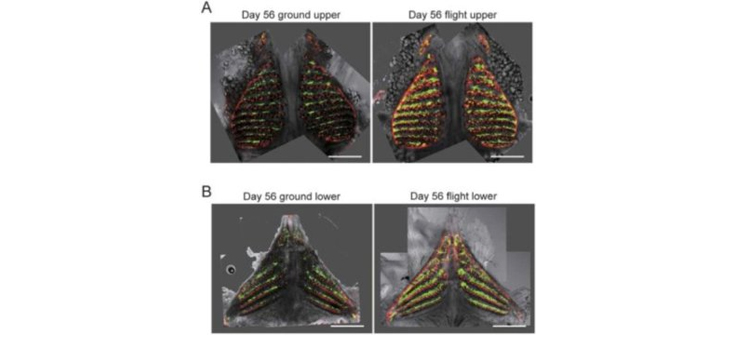
What can fish in space tell us about bone loss? Scientists are trying to find out. A team of researchers went in search of answers to the question, “Why do astronauts lose bone mineral density in flight?” To that end, they raised freshwater fish (Medaka) aboard the International Space Station for 56 days and examined the animals’ jawbones and teeth for any potential effects from microgravity.
Fish in Space…and Bone Loss
2 min read Premium comments
Secondary
According to the January 25, 2016 news release, “A paper based on the Medaka results was recently published in Scientific Reports. Co-author and principal investigator Akira Kudo, a professor in the Graduate School of Bioscience and Biotechnology at Tokyo Institute of Technology, said investigators found increased volume and activity of osteoclasts and significant reduction of bone mineral density in the fish aboard the station. Using electron microscopes, investigators also observed abnormalities in osteoclast mitochondria. Mitochondria are round or rod-shaped organelles inside most of our cells that produce enzymes for converting food to energy. Genetic analysis also revealed significant increase in activity in two genes that may be involved in mitochondria function, suggesting that osteoclast activation might be linked to the reaction of mitochondria to microgravity.”
“The fish in space showed normal body growth even though they had decreased mineral density in bones and teeth. The investigators observed the fish regularly and while the Medaka swam normally at first, they tended to become motionless late in the flight. This indicates that microgravity’s effect on bone density likely involves changes in mechanical force that lowers overall physical activity and therefore causes osteoclast activation.”
Dr. Kudo told OTW, “The precise molecular mechanisms responsible for loss of bone density are not yet understood. The current study is a first step towards uncovering the reasons why bone structure is affected. Our results showed that osteoclast formation and activity in Medaka fish under a microgravity environment are activated, which is linked with mitochondria function. If this is also true for astronauts in space, agonistic medicines for mitochondria dysfunction may restore the bone loss in space.”
“It has been difficult to understand the mechanism of the age-related osteoporosis, because we do not have a good animal model for the disease. The Medaka experiment in space is a good animal model. Our finding of new genes that were up-regulated under microgravity provides a good tool to clarify this mechanism.”
Author
React:
Discussion
This is a fascinating development. In my practice we've seen similar outcomes with the revised protocol. The key differentiator seems to be patient selection criteria. Has anyone else noticed the correlation with BMI thresholds?
Great point. I'd push back slightly on the conclusion, the sample size in the cited study is too small to draw population-level inferences. That said, the directional signal is compelling and worth a larger RCT.
We implemented a similar approach last year. Early results are promising but we're still gathering 12-month follow-up data. Happy to share our protocol if anyone is interested.
Join the conversation
Orthopedic professionals are discussing this. Sign in and upgrade to read every comment and add your voice.