
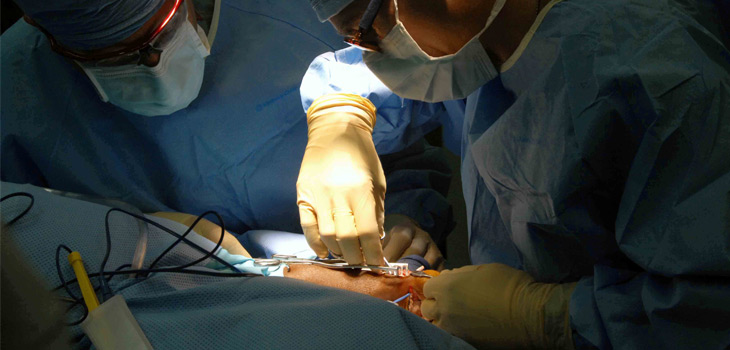
Sam Barnes, a retired orthopedic surgeon from Tennessee, who broke his ankle several years ago, recently had a complete ankle replacement installed. The night before the surgery he attended a run-through of the procedure on a cadaver with his surgeon James McKinney, M.D., who wanted a test run before operating on his colleague. Besides the surgeon and his patient, company representatives were also on hand for the trial run surgery.
Patient Attends Surgical Run-Through on Cadaver
1 min read Premium comments
Secondary
The ankle that was implanted is called the Scandinavian Total Ankle Replacement (STAR). According to Herald Citizen of Cookeville, Tennessee, writer Laura Militana, the ankle device is the only three piece mobile bearing non constrained, uncemented total ankle replacement to receive pre-market approval to replace a painful arthritic ankle joint due to post traumatic arthritis or rheumatoid arthritis
Militana wrote that fusion of the ankle had not been a recommended option for Barnes and the successful replacement surgery took about two hours.
According to the Small Bone Innovations’ website, the STAR Ankle prosthesis consists of three components:
- A tibial component with a highly polished flat articulation surface and two cylindrical fixation bars on the proximal side of tibia to anchor the implant in the subchondral bone of the tibia.
- A talar component, also available in five different sizes for right and left. A ridge running anteroposteriorly in the middle of the gliding surface guides the ultra high molecular weight polyethylene mobile bearing sliding core.
- The mobile bearing is a sliding core, the flat surface of which articulates with the tibial component while the concave shaped underside articulates with the convex shaped talar component. The anteroposterior articulation is guided by the longitudinal ridge on the talar component and the matching longitudinal groove in the underside of the mobile bearing sliding core.
Barnes told Militana that his pain has declined by 50% and he would recommend the implant, which he estimates can last for 10 years, to anyone who needs an ankle replacement.
Author
React:
Discussion
This is a fascinating development. In my practice we've seen similar outcomes with the revised protocol. The key differentiator seems to be patient selection criteria. Has anyone else noticed the correlation with BMI thresholds?
Great point. I'd push back slightly on the conclusion, the sample size in the cited study is too small to draw population-level inferences. That said, the directional signal is compelling and worth a larger RCT.
We implemented a similar approach last year. Early results are promising but we're still gathering 12-month follow-up data. Happy to share our protocol if anyone is interested.
Join the conversation
Orthopedic professionals are discussing this. Sign in and upgrade to read every comment and add your voice.