
Medtech SA has recently announced that it has received 510(k) clearance from the FDA to market the ROSA Spine robot in the United States.
Medtech SA: 510(k) From FDA for ROSA Spine Robot
2 min read Premium comments
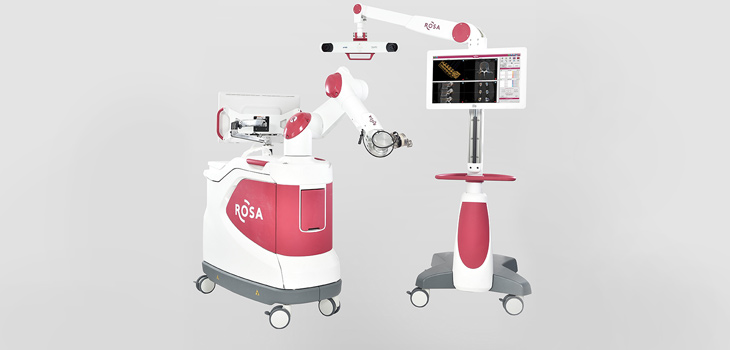
Secondary
Bertin Nahum, CEO and Founder of Medtech, said in the January 5, 2016 news release, “We are thrilled to have FDA approval for ROSA Spine. Building on the success that ROSA™ Brain has encountered on the American market, this new key regulatory milestone will allow us to strengthen our position in the world’s leading market for spine surgery. In addition, the FDA approval again reflects our capacity to respect the commitments we made at the time of our IPO, growing as a company while offering innovative robotic technology.”
According to the news release, “ROSA Spine received the CE Mark in 2014 and is currently being used in minimally invasive spine surgery. The first commercial procedure in Europe was performed in December 2014 at the Neurosurgery Department of Amiens-Picardy University Hospital to treat a patient with a degenerative spine disorder through a lumbar fusion with a posterior approach. The ROSA platform was previously approved in the U.S. for brain surgery in 2012. There are currently 27 ROSA Brain systems installed in American facilities.”
Nahum told OTW, “Development of the ROSA Spine robot, devoted to spine surgery, began in 2012. ROSA™ Spine is capable of performing minimally invasive spine surgery. Authorization to sell the device on the European market (CE mark) was obtained in July 2014 and the first surgical operation was performed in November 2014. Clearance for the American market (FDA approval) was granted in January 2016. In developing the latest generation of surgical assistance robots, Medtech’s ambition is to establish surgical procedures which are less-invasive and safer for the patient, and to offer surgeons greater accuracy and safety.”
“Thanks to our robots, surgery is changing, moving from an open approach to a minimally invasive approach, and surgeons no longer need to make large incisions to operate. As for the patients, the recovery time is shortened and the risk of infection is reduced. The ROSA device is innovative in two ways. From a technological viewpoint, ROSA has a robot arm whose architecture imitates the movements of a human arm, conferring great dexterity to the surgeon’s movements and complete freedom in the choice of trajectory. ROSA also gives them the possibility of guiding the instruments by hand, within the limits established during the planning stage, while giving him all the advantages of robotic movement. This new platform allows real-time monitoring of patient movements and compensates for these movements without the necessity to stabilize the robot using the surrounding vertebrae.”
“Minimally invasive spine surgery shares the same difficulties as brain surgery, such as reduced visual field, but includes added complications like the inability to fully immobilize the patient. Accurate intraoperative planning is obtained with ROSA Spine. During surgery, patients need to breathe, and when the surgeon operates he exerts pressure on the patient causing the spine to move. To overcome this movement, surgeons operating without robot-assistant systems have to compensate for the body’s movement, decreasing surgical accuracy. Previously developed robots for spine surgery assistance were designed to be bone-mounted but, due to its weight and stability, the ROSA Spine robotic arm offers firm, accurate instrument guidance. Moreover, it has a dynamic guidance system that tracks and responds to patient movement in real time, providing compensation for the body’s movements without the additional risk of clamping onto the spine.”
React:
Discussion
This is a fascinating development. In my practice we've seen similar outcomes with the revised protocol. The key differentiator seems to be patient selection criteria. Has anyone else noticed the correlation with BMI thresholds?
Great point. I'd push back slightly on the conclusion, the sample size in the cited study is too small to draw population-level inferences. That said, the directional signal is compelling and worth a larger RCT.
We implemented a similar approach last year. Early results are promising but we're still gathering 12-month follow-up data. Happy to share our protocol if anyone is interested.
Join the conversation
Orthopedic professionals are discussing this. Sign in and upgrade to read every comment and add your voice.