
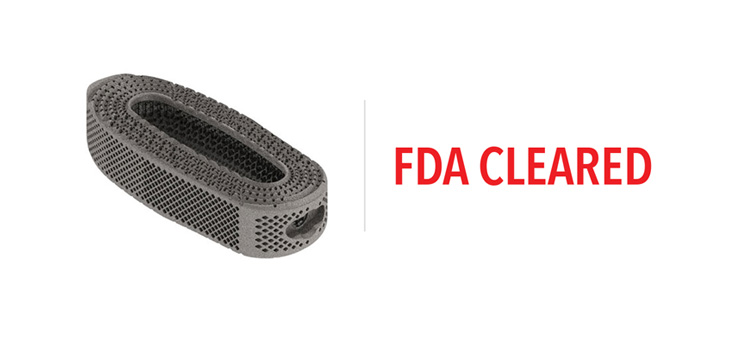
K2M Group Holdings, Inc. has received FDA 510(k) clearance to market Cascadia, its third lateral interbody system featuring the company’s Lamellar Titanium Technology. The company also received FDA 510(k) clearance and a CE Mark for the Cascadia AN and TL interbody systems in 2015.
K2M’s Third Titanium Lateral Interbody System Cleared by FDA
2 min read Premium comments
Secondary
Lamellar Titanium Technology
Lamellar titanium technology is the company’s proprietary technology that uses 3D printing with the goal of allowing for bony integration throughout an implant. In addition to U.S. regulatory clearance, K2M also received a CE Mark for the system.
According to a January 8, 2015 company announcement, the technology uses “an advanced 3D printing method to create structures that were once considered impractical with traditional manufacturing techniques. Starting with a titanium powder, the implants are grown through the selective application of a high-energy laser beam, allowing for the incorporation of both a porosity and surface roughness that pre-clinical data have associated with bone growth activity.”
In December 2015 Pierce Nunley, M.D., director of the Spine Institute of Louisiana, completed the first surgical case using the Cascadia system. He said the design of the implant offers him, “a greater bone graft volume than my normal Aleutian PEEK implant, while increasing the endplate contact surface area and still allowing me the ability to radiographically evaluate the fusion.” The increased endplate contact is accomplished through the implant’s hourglass design.
Nunley added that by incorporating the porosity and rough surfaces of the Lamellar technology into the lateral interbodies, an alternative now exists to the traditional PEEK and Titanium cages commonly used in direct lateral fusion procedures.
The company says its technology incorporates titanium with a surface roughness of 3-5 microns and is designed to allow for direct bony ongrowth. The technology also incorporates 500 micron longitudinal channels throughout the implant which, in conjunction with traverse windows, create an interconnected lattice designed to allow for bony integration.
The system includes a full range of implant sizes and is designed to work in conjunction with the company’s Ravine lateral access system, offering a full line of instrumentation for the far lateral transpsoas approach.
Eric Major, K2M’s president and CEO, said the regulatory milestones, coupled with the successful completion of the first surgical case late last year, “underscore our commitment to expanding our minimally invasive spine portfolio by bringing innovative and differentiated technologies and products to the global spine market.”
Author
React:
Discussion
This is a fascinating development. In my practice we've seen similar outcomes with the revised protocol. The key differentiator seems to be patient selection criteria. Has anyone else noticed the correlation with BMI thresholds?
Great point. I'd push back slightly on the conclusion, the sample size in the cited study is too small to draw population-level inferences. That said, the directional signal is compelling and worth a larger RCT.
We implemented a similar approach last year. Early results are promising but we're still gathering 12-month follow-up data. Happy to share our protocol if anyone is interested.
Join the conversation
Orthopedic professionals are discussing this. Sign in and upgrade to read every comment and add your voice.