
The FDA intends to publish a number of guidance documents in 2016. The agency also wants to hear from you regarding whether or not previously issued final guidances should be revised or withdrawn.
FDA Seeks Input on Intended 2016 Guidance Documents
2 min read Premium comments
Secondary
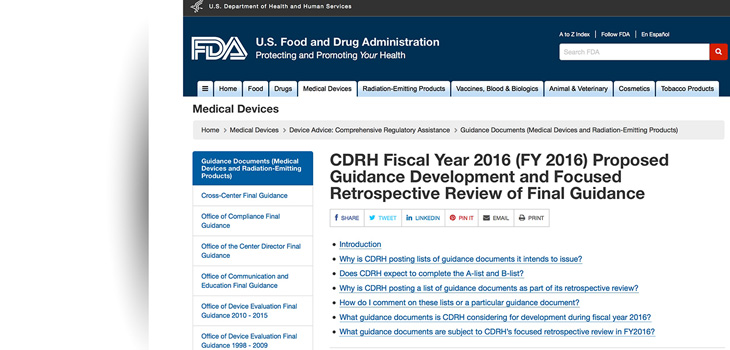
On December 28, 2015, the agency provided three lists for comment.
“A-List”
The “A-List” contains guidance documents the agency fully intends to publish during the upcoming year.
Draft guidance topics include:
- Medical Device Decision Support Software
- Use of Symbols in Labeling
- 510(k) Modifications
- Software Modifications
- 510(k) Third Party Review Program
- Companion Diagnostics Co-Development
- Use of Real-World Observational Patient Data to Support Decision Making for Medical Devices
- UDI Convenience Kit
- Public Notification of Emerging Postmarket Medical Device Signals
“B-List”
The “B-List” contains guidance documents the agency intends to publish “as resources permit.”
Draft guidance topics include:
- Medical Device Interoperability
- Patient Access to Information
- Evaluation and Reporting of Age, Race, and Ethnicity Data in Medical Device Clinical Studies
- Patient Matched Instrumentation for Orthopedics
- Dual 510(k) and Clinical Laboratory Improvement Amendments Act (CLIA) Waiver by Application
- Defining the Unique Device Identifier (UDI)
“C-List”
The “C-List” contains final guidance documents that were issued in 2006, 1996, 1986, and 1976, subject to “focused retrospective review.”
Final guidance documents include:
- Panel Report and Recommendations on PMA Approvals #P86-5 (Blue Book Memo)
- Statistical Guidance for Clinical Trials of Non Diagnostic Medical Devices
- Indications for Use Statement
- Medical Device Reporting: An Overview
- Guidance Document For Testing Bone Anchor Devices
- Guidance Document for Testing Biodegradable Polymer Implant Devices
- Continued Access to Investigational Devices During PMA Preparation and Review July 15, 1996 (Blue Book Memo D96-1)
- The Establishment and Operation of Clinical Trial Data Monitoring Committees for Clinical Trial Sponsors
Submitting Comments
The agency’s Center for Devices and Radiological Health (CDRH) invites you to submit comments to docket FDA-2012-N-1021. Comments may include draft language on the proposed A-list and B-list topics, suggestions for new or different guidance documents, for which commenters should state the potential guidance topic, reasons the guidance is needed, and proposed policy or information for FDA to consider on the topic, or the relative priority of guidance documents.
The agency says you may also include suggestions that CDRH revise or withdraw a final guidance document that issued previously as part of its retrospective review, for which commenters should address why the guidance document should be revised or withdrawn and, if applicable, how it should be revised.
You can submit written comments to the Division of Dockets Management (HFA-305), Food and Drug Administration, 5630 Fishers Lane, Rm. 1061, Rockville, MD 20852. Submit electronic comments to http://www.regulations.gov. Current FDA and CDRH guidance documents can be found on the CDRH Guidance Document Web page. http://www.fda.gov/MedicalDevices/deviceregulationandguidance/guidancedocuments/default.htm.
Author
React:
Discussion
This is a fascinating development. In my practice we've seen similar outcomes with the revised protocol. The key differentiator seems to be patient selection criteria. Has anyone else noticed the correlation with BMI thresholds?
Great point. I'd push back slightly on the conclusion, the sample size in the cited study is too small to draw population-level inferences. That said, the directional signal is compelling and worth a larger RCT.
We implemented a similar approach last year. Early results are promising but we're still gathering 12-month follow-up data. Happy to share our protocol if anyone is interested.
Join the conversation
Orthopedic professionals are discussing this. Sign in and upgrade to read every comment and add your voice.