
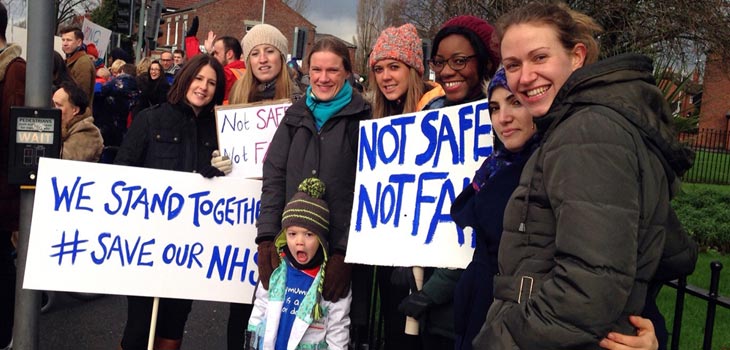
English junior doctors, who work for the National Health Service (NHS) went on a one-day strike on January 12, 2016 to protest a new employment contract offered by the government.
English Junior Docs Strike
2 min read Premium comments
Secondary
While unheard of the in the U.S., physicians in Europe will take to the picket lines. German physicians went on strike in 2006 and 2010. Then Moscow physicians struck in 2015. Now, according to Reuters, English junior physicians are striking for the first time in 40 years.
Junior doctors are physicians in training who make up just over half of all physicians in the state-funded NHS.
Ninety-eight percent of more than 37, 000 junior doctors in England voted for strikes in protest against the new contract proposed by Health Secretary Jeremy Hunt. Physicians in the rest of Britain are not involved.
The government says the new contract will deliver more consistent service seven days a week. Reuters reports that studies have shown that mortality rates are higher on weekends when staffing is reduced. The new deal would see the junior physicians given a pay rise but some anti-social hours for which they are currently paid a premium would be considered to be standard.
The doctors’ union the British Medical Association said the contract does not provide proper safeguards against doctors working dangerously long hours.
The Telegraph reports that trainee doctors currently have a starting salary of £22, 636 ($24, 630 roughly USD), rising with experience to reach £30, 000 ($32, 644 USD) within four years. Doctors in specialist training receive a salary of between £30, 002 and £47, 175 ($51, 333 USD), while those who make the grade can earn up to £69, 325 ($75, 436 USD). (£1 = $1.44)
Public Support
According to an Ipsos MORI poll for BBC Newsnight and the Health Service Journal, most people in England are supportive of the strikes, as long as emergency care is still provided. The survey of 869 adults in England found 66% were supportive, with 41% strongly supportive. Only 16% were against the strikes.
The physicians said they would only provide emergency services during the 24-hour walkout. They are planning a 48-hour stoppage later in January with a full withdrawal of labor, including emergency care, for nine hours on February 10, 2016.
The government expects some 4, 000 non-emergency operations to be canceled during the stoppage.
One junior doctor, Dr. Lamia Zafrani of the Stepping Hill Hospital in the norther city of Stockport, told the Al Jazeera news outlet that the government was taking advantage of junior doctors because they were locked in training programs that could last up to 10 years.
“As junior doctors, we work hard, we work unsociable hours and we work weekends…staying behind after work to make sure things are safe. The NHS runs on the goodwill of its staff, ” Zafrani said.
Author
React:
Discussion
This is a fascinating development. In my practice we've seen similar outcomes with the revised protocol. The key differentiator seems to be patient selection criteria. Has anyone else noticed the correlation with BMI thresholds?
Great point. I'd push back slightly on the conclusion, the sample size in the cited study is too small to draw population-level inferences. That said, the directional signal is compelling and worth a larger RCT.
We implemented a similar approach last year. Early results are promising but we're still gathering 12-month follow-up data. Happy to share our protocol if anyone is interested.
Join the conversation
Orthopedic professionals are discussing this. Sign in and upgrade to read every comment and add your voice.