
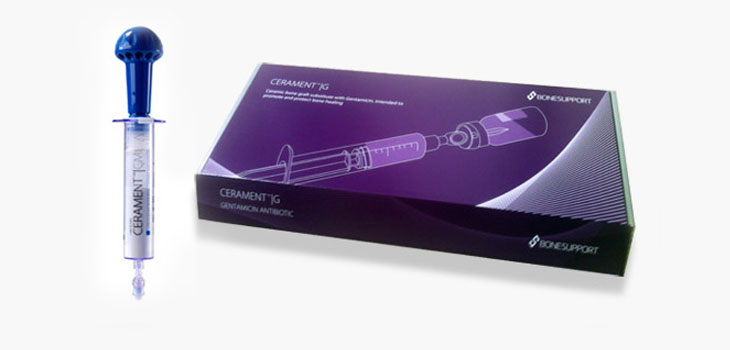
Bonesupport, a company in Lund, Sweden, announces the results of two studies that confirm the efficacy of the firms CERAMENT™|G antibiotic eluting bone substitute technology. The material is used in the management of osteomyelitis (OM) in infected diabetic feet. According to Bonesupport officials CERAMENT™|G, which releases Gentamicin, is the first approved antibiotic eluting bone substitute indicated to promote and protect bone healing in the management of bone infections. The product received the CE-mark in 2013.
Diabetic Foot Ulcers Respond to Bonesupport Medication
2 min read Premium comments
Secondary
Contiguous bone infection is a common complication of diabetic foot ulcers. Approximately 20% of patients with a diabetic foot infection have underlying osteomyelitis. Diabetes is the most common cause of non-traumatic lower limb amputation, with approximately 30% of patients with a diabetic foot ulcer facing the probability of amputation. The risk for amputation in acute diabetic infections is four times higher with OM than it is with soft tissue infection alone. Fifty percent of patients who have had one amputation will go on to another amputation within three to five years, and 70% of patients die within five years of an amputation for diabetes.
“The data generated from these studies support the feedback we’ve received from European physicians regarding the efficacy of CERAMENT™|G, ” said Lloyd Diamond, CEO of BONESUPPORT. “Our physician adoption rate in Europe continues to grow significantly, and we anticipate initiating a U.S. clinical trial for CERAMENT™|G in the second quarter of 2016.”
The studies confirmed previously unpublished experience with CERAMENT™|G which was shown to induce bone and soft tissue healing and preservation of proper anatomy in the infected diabetic foot. Eleven of 12 patients who had mid-foot or hind foot partial resections healed rapidly. In the second study doctors managed six patients with OM of the metatarsal head with CERAMENT™|G, with none requiring additional surgery.
“The results of these studies confirm that CERAMENT™|G has the potential to be an effective new surgical option for patients with osteomyelitis, ” said Enrico Brocco, M.D., chief, Diabetic Foot Unit, Policlinico Abano Terme, Diabetic Foot Referral Center, Italy, and author of one of the studies. “In these studies, CERAMENT™|G was associated with the rapid resolution of osteomyelitis, rapid soft tissue closure and preservation of the foot structure. We are very optimistic that CERAMENT™|G holds great promise in the management of osteomyelitis in diabetic foot ulcers.
Author
React:
Discussion
This is a fascinating development. In my practice we've seen similar outcomes with the revised protocol. The key differentiator seems to be patient selection criteria. Has anyone else noticed the correlation with BMI thresholds?
Great point. I'd push back slightly on the conclusion, the sample size in the cited study is too small to draw population-level inferences. That said, the directional signal is compelling and worth a larger RCT.
We implemented a similar approach last year. Early results are promising but we're still gathering 12-month follow-up data. Happy to share our protocol if anyone is interested.
Join the conversation
Orthopedic professionals are discussing this. Sign in and upgrade to read every comment and add your voice.