
Midwest Orthopaedics at Rush is celebrating these days…five of its physicians were named among the Chicago area’s “Top Doctors” in the January 2016 issue of Chicago Magazine. They include: Drs. Howard An, Steven Gitelis, Joshua Jacobs and Anthony Romeo (orthopedic surgery) and Mark Cohen for hand surgery. (Pictured on right. In the left column: Dr. Cohen, Dr. Gitelis and Dr. Romeo. In the right column: Dr. Jacobs and Dr. An)
5 Rush Surgeons Among Chicago’s “Top Docs”
2 min read Premium comments
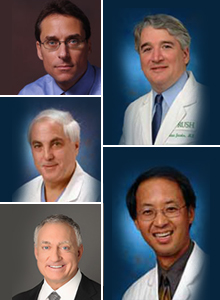
Howard An, M.D. is a spine, back and neck surgeon at Midwest Orthopaedics at Rush. He is also the Morton International Endowed Chair Professor of Orthopedic Surgery, Director, Division of Spine Surgery and Spine Fellowship Program, Rush University Medical Center.
OTW asked each of these esteemed surgeons about their current research.
Dr. An told OTW, “There are millions of patients with low back pain due to intervertebral disc degeneration, and future treatment will be biological repair or regeneration of degenerated disc tissue. Cell therapy for intervertebral disc degeneration is being investigated as a biologic treatment, and we are actively doing research in this area into 2016.”
Mark Cohen, M.D. is the Co-Director of the Midwest Orthopaedics at Rush Hand, Wrist and Elbow Institute. He has won several research, teaching and achievement awards and is a member of 16 national and international medical societies and associations.
Dr. Cohen told OTW, “We are researching the long term follow-up of a radial head implant that I helped design. We now have some 10 year results that are quite favorable.”
Steven Gitelis, M.D. specializes in orthopedic oncology and joint reconstruction and replacement at Midwest Orthopaedics at Rush. Dr. Gitelis currently serves as the Director of the Rush Center for Limb Preservation.
Dr. Gitelis noted, “We plan to look at chemotherapy resistance in osteosarcoma at a molecular biological level to try to better understand this daunting problem. This potentially can help many children with this cancer.”
Joshua Jacobs, M.D. is a joint replacement orthopedic surgeon at Midwest Orthopaedics at Rush. In 2013, he served as President of the American Academy of Orthopaedic Surgeons (AAOS).
Dr. Jacobs commented to OTW, “Adverse Local Tissue Reactions (ALTR) due to tribocorrosion at modular junctions of total hip replacement (THR) components has emerged as an increasingly common reason for failure. In collaboration with experts in the fields of materials science, electrochemistry, biomechanics, tribology and histopathology, orthopaedic surgeons in our group will continue research aimed at gaining an understanding of the mechanism(s) of ALTR to mitigate, and ultimately prevent, this failure mode. Improved clinical detection algorithms as well as improvements in the tribocorrosion resistance of THR components are the most promising areas of research likely to have a significant impact on this phenomenon.”
Anthony Romeo, M.D. is an orthopedic surgeon with more than 20 years of experience working in academic medicine. Dr. Romeo has been selected to be President of the American Shoulder and Elbow Surgeons from 2017-2018. He also serves as co-team physician for the Chicago White Sox and the Chicago Bulls.
Dr. Romeo noted, “There are two areas that I find exciting. The first is the use of sophisticated imaging program to preoperative plan shoulder replacements and develop patient specific instrumentation to improve the accuracy and precision of the procedure. In addition, we will be evaluating the impact of stem cells on the ability to improve the results of rotator cuff repairs, including the healing rate of the tendon to bone, and overall clinical outcome.”
React:
Discussion
This is a fascinating development. In my practice we've seen similar outcomes with the revised protocol. The key differentiator seems to be patient selection criteria. Has anyone else noticed the correlation with BMI thresholds?
Great point. I'd push back slightly on the conclusion, the sample size in the cited study is too small to draw population-level inferences. That said, the directional signal is compelling and worth a larger RCT.
We implemented a similar approach last year. Early results are promising but we're still gathering 12-month follow-up data. Happy to share our protocol if anyone is interested.
Join the conversation
Orthopedic professionals are discussing this. Sign in and upgrade to read every comment and add your voice.