
The FDA has granted clearance to the world’s smallest wireless eight-electrode spinal cord stimulator (SCS) system. The agency granted clearance to a four-electrode device last year made by the same company.
Wireless Spinal Cord Stimulator Cleared by FDA
1 min read Premium comments
Secondary
On December 9, 2015, Stimwave Technologies Inc. announced FDA clearance of its Stimwave Freedom-8A SCS system. The company says its system is the world’s first wireless, fully programmable SCS neuromodulation device available and “presents a potentially life-changing technological breakthrough” for more than 90 million people in the U.S. with daily chronic back and leg pain.
The company has also begun commercialization of the device and began implanting in the first patients earlier this quarter. Full nationwide commercialization is planned for the first of the year.
Laura Tyler Perryman, the company’s chairman and CEO said, “Patients utilizing the Stimwave Freedom-8A and Freedom-4A products not only have the option of a wireless device, but the recent advancements in this technology’s platform also provide the majority of the programming and placement features available from wired systems that are 95 percent larger.” She added that a current FDA approved clinical trial is looking at the safety and efficacy of even wider programmability options, or high-frequency programming up to 10, 000 Hz.
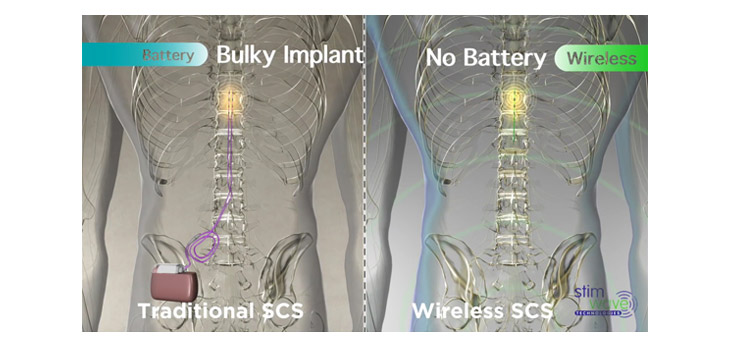
The wireless option eliminates the need for tunneling and placement of internal batteries in the patient’s body. Stimwave’s stimulator is implanted in an outpatient procedure through a standard needle with no need for general anesthesia or a large surgical incision. The company believes this approach is expected to significantly reduce the lifetime cost of care for chronic pain patients and offer a safe, viable and effective alternative to pain medications.
The technology leverages a tiny, state-of-the-art device that delivers small pulses of energy, in a fully-selectable manner, to eight electrodes placed near surrounding nerves, triggering a reaction that enables the brain, according to the company, to remap specific pain signals, thus providing pain relief.
Author
React:
Discussion
This is a fascinating development. In my practice we've seen similar outcomes with the revised protocol. The key differentiator seems to be patient selection criteria. Has anyone else noticed the correlation with BMI thresholds?
Great point. I'd push back slightly on the conclusion, the sample size in the cited study is too small to draw population-level inferences. That said, the directional signal is compelling and worth a larger RCT.
We implemented a similar approach last year. Early results are promising but we're still gathering 12-month follow-up data. Happy to share our protocol if anyone is interested.
Join the conversation
Orthopedic professionals are discussing this. Sign in and upgrade to read every comment and add your voice.