
A group of researchers from Cedars-Sinai in Los Angeles is now closer to developing new treatments for patients with osteoporosis and spinal compression fractures. They found that using a combination of adult stem cells and parathyroid hormone (PTH) significantly increased new bone formation—and may speed healing for human bone fractures caused by osteoporosis.
SC and PTH Increase Bone Formation, Speed Healing
2 min read Premium comments
Secondary
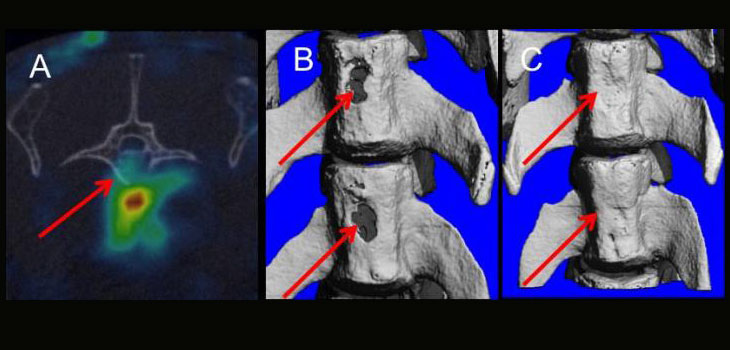
As indicated in the December 8, 2015 news release, “For 21 days, laboratory rats and pigs with vertebral fractures received daily injections of PTH. During the same period, the animals also were injected with five doses of stem cells. The study shows that the combination therapy significantly enhanced the stem cells’ migration to the area of the bone fracture and increased the formation of new, healthy bone.”
“We have known that used separately, both the stem cells and the hormone each have an effect on the healing process involved in bone fractures, ” said Dan Gazit, D.M.D., Ph.D., co-director of the Skeletal Regeneration and Stem Cell Therapy Program in the Department of Surgery and Cedars-Sinai Board of Governors Regenerative Medicine Institute. “Now, we have learned that the stem cells and PTH are much stronger combined than they are separately.”
Said study co-author Zulma Gazit, Ph.D., co-director of the Skeletal Regeneration and Stem Cell Therapy Program, “Currently, there aren’t many good options for treatment. So our goal is to develop a biological treatment that not only promotes healing but also stimulates normal bone production.”
“We saw increased bone volume density and healthy bone formation only in the lab animals treated with both stem cells and hormone therapy, ” Zulma Gazit said. “Over the course of the study, we saw three-to-four times more healing in the groups that were treated with the combination.”
Gadi Pelled, Ph.D., assistant professor at the Skeletal Regeneration and Stem Cell Therapy Program and senior co-author of the study, told OTW, “The Gazit group has been studying the use of PTH for fracture repair for several years. One of the intriguing effects of PTH that we and others have noticed was that its administration led to endogenous stem cell recruitment and activation. Hence, we hypothesized that if we would ‘boost’ the number of circulating stem cells (mesenchymal stem cells in our case) combined with PTH administration, we would generate a synergistic effect that would accelerate fracture repair.”
“It is important to know that combining IV-injected mesenchymal stem cells and PTH yields a synergistic effect on fracture repair in osteoporotic animals. Also, osteoporosis patients with vertebral compression fractures might benefit from a combined treatment of PTH and IV-injected mesenchymal stem cells. PTH enhanced the migration of mesenchymal stem cells to bone injury sites, where they differentiated to bone-cells.”
React:
Discussion
This is a fascinating development. In my practice we've seen similar outcomes with the revised protocol. The key differentiator seems to be patient selection criteria. Has anyone else noticed the correlation with BMI thresholds?
Great point. I'd push back slightly on the conclusion, the sample size in the cited study is too small to draw population-level inferences. That said, the directional signal is compelling and worth a larger RCT.
We implemented a similar approach last year. Early results are promising but we're still gathering 12-month follow-up data. Happy to share our protocol if anyone is interested.
Join the conversation
Orthopedic professionals are discussing this. Sign in and upgrade to read every comment and add your voice.